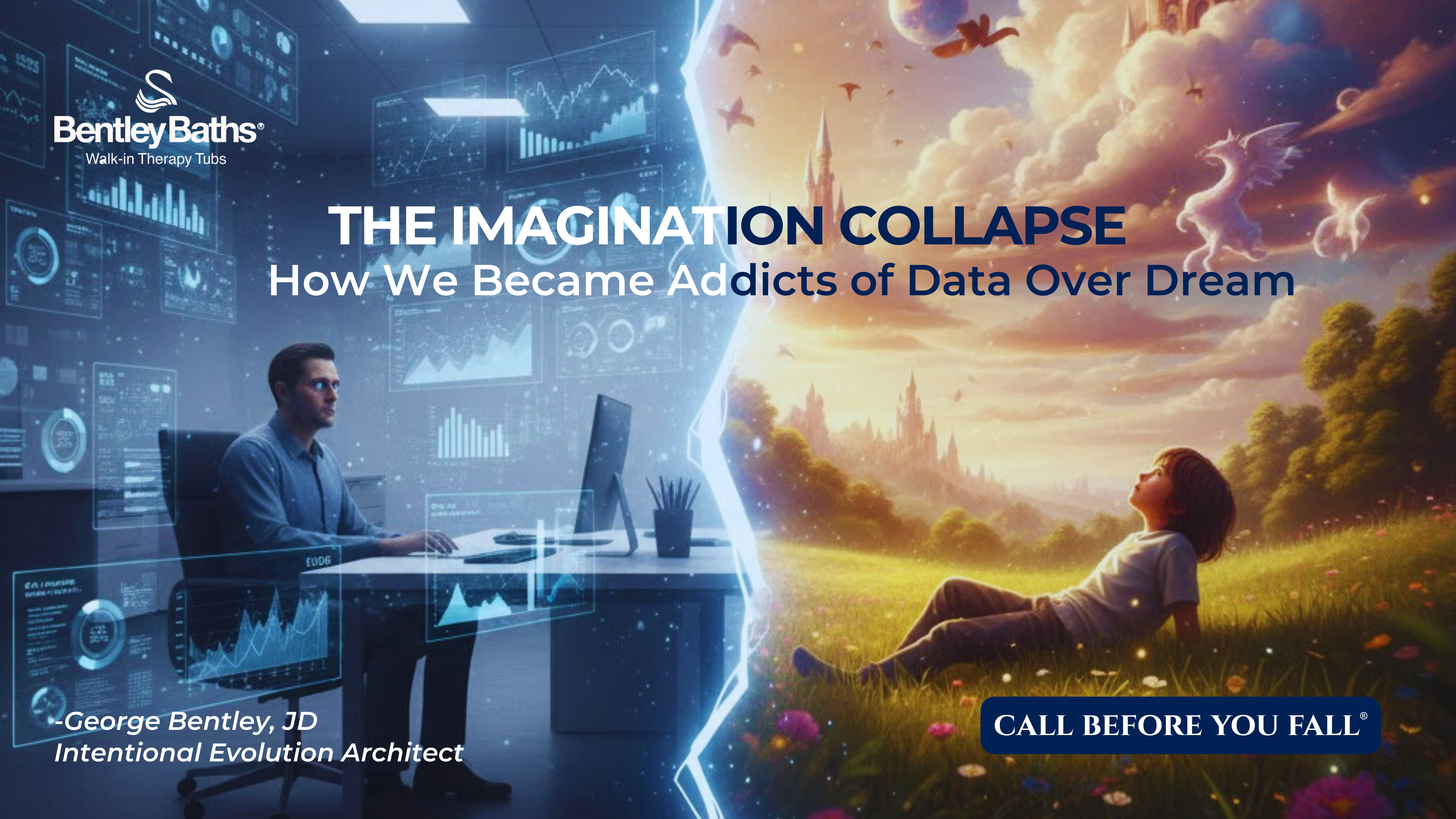
Remember when you used to stare at clouds and see castles?
Now you stare at dashboards and call it vision.
We’ve replaced imagination with information. We confuse input with insight. We’ve let metrics choke out magic. Somewhere along the line, imagination went from sacred act to childish relic—the domain of dreamers, not doers. But here’s the lie: You can’t build the future without seeing what isn’t there yet.
And you can’t see it if you’ve outsourced all vision to validation.
Enemy Phrase: “Data-driven thinking”
New Phrase: “Imagination discipline”
The Contradiction
We revere innovation, but mock imagination.
Look around. Business books preach disruption. Schools worship STEM. Startups scream about innovation. But the minute someone proposes an idea without a case study or market proof, they get laughed out of the room. Why?
Because we’ve mistaken analysis for foresight.
Data-driven thinking is a weapon when wielded after vision. Used before it? It’s a leash. It anchors you to what already exists. And nothing revolutionary was ever built by obeying what already exists.
Scene
I sat in a strategy meeting where someone suggested we imagine what the industry would look like if it collapsed and had to be rebuilt from scratch. Silence. Then laughter. Then someone said, “Let’s stay realistic.”
That moment? That was the imagination collapse in real-time.
The Truth
Realism is just consensus with better PR.
If you want to build a different world, you have to suspend the current one. That takes imagination. Not the Pinterest-board kind. The uncomfortable kind. The kind that doesn’t fit your quarterly roadmap.
Imagination discipline isn’t fantasy. It’s focus. It’s the trained refusal to let what “is” define what “could be.”
Language Installation
“Data-driven thinking” is praised like gospel. But in practice, it’s often fear disguised as intelligence. It demands proof before possibility. It rewards pattern over originality. It’s a thermostat for creativity: never too hot, never too cold.
Imagination discipline is the opposite. It doesn’t reject data—it reschedules it. It treats vision as primary, evidence as secondary. It demands that you invent before you optimize.
Use the phrase like a lighthouse. If your team isn’t practicing imagination discipline, you’re just A/B testing your way to mediocrity.
Evidence
Einstein said, “Imagination is more important than knowledge.”
What he meant: knowledge is gravity. Imagination is flight.
Every major leap—from electricity to the internet—began with a what-if, not a pie chart. Steve Jobs didn’t ask for focus group data before sketching the iPhone. James Cameron dreamed the entire world of Pandora before a single frame was rendered. Imagination wasn’t the garnish. It was the source code.
CTA
Audit your environment. Who gets rewarded more: the one with the best analysis, or the boldest vision?
Then go one step further: block 30 minutes this week for imagination discipline. No slides. No spreadsheets. Just questions with no data to answer them yet.
That’s where the real work begins.