Skip to content

George Bentley
In the first installment of this multi-part blog, I related the scope of the problems that lead to older adults falling and injuring themselves in the bathroom. In this, the second installment, I detail the first of two issues that cause these problems to go unresolved until, in many cases, it is too late.
Epidemic #1: Ignorance – It’s Impossible to Know What You Don’t Know
As I was growing up, my father was fond of reminding me that it’s impossible to know what you don’t know. He would frequently say this to me in situations where I was struggling to figure out an answer to a problem when I didn’t have all the necessary information. This is a very appropriate analogy as it relates to seniors dealing with their bathrooms. It also very pointedly explains what happened to my family and specifically to my mother.
Who goes into their bathroom and expects the bathroom to change as they age? Nobody. Yet the fact remains that every day we live, every trip we take around the sun, we get a year older, we get weaker, and we become less stable. Our connective tissues weaken, our skin thins, we begin to lose our vision, and we begin to lose our hearing. These are all just facts of life. However, it is not a fact of our life to expect our bathrooms to change to accommodate us as we go through these physical changes due to age.
I have interviewed thousands of seniors, their adult children, and their caregivers, and in many of those interviews I’ve requested that the senior demonstrate for me how they enter and exit their existing bathtub or shower. If it’s at all possible, I try to arrange the situation so that the spouse, adult child or caregiver can observe this process from the bathroom door or hallway.
 I now have videos of many of these transitions on the internet. Visit Bentley Baths’ YouTube Channel (http://www.youtube.com/user/BentleyBaths?feature=watch) or search for “Bentley Baths” or “Senior Falls” on YouTube. These videos are candid and shockingly real, and are almost always the first time a spouse, adult child or loved one sees the reality of what getting into or out of a bathtub or shower can be like. I will be putting more such info up all the time, so keep checking back.
So, let’s discuss what the results of my interviews revealed.
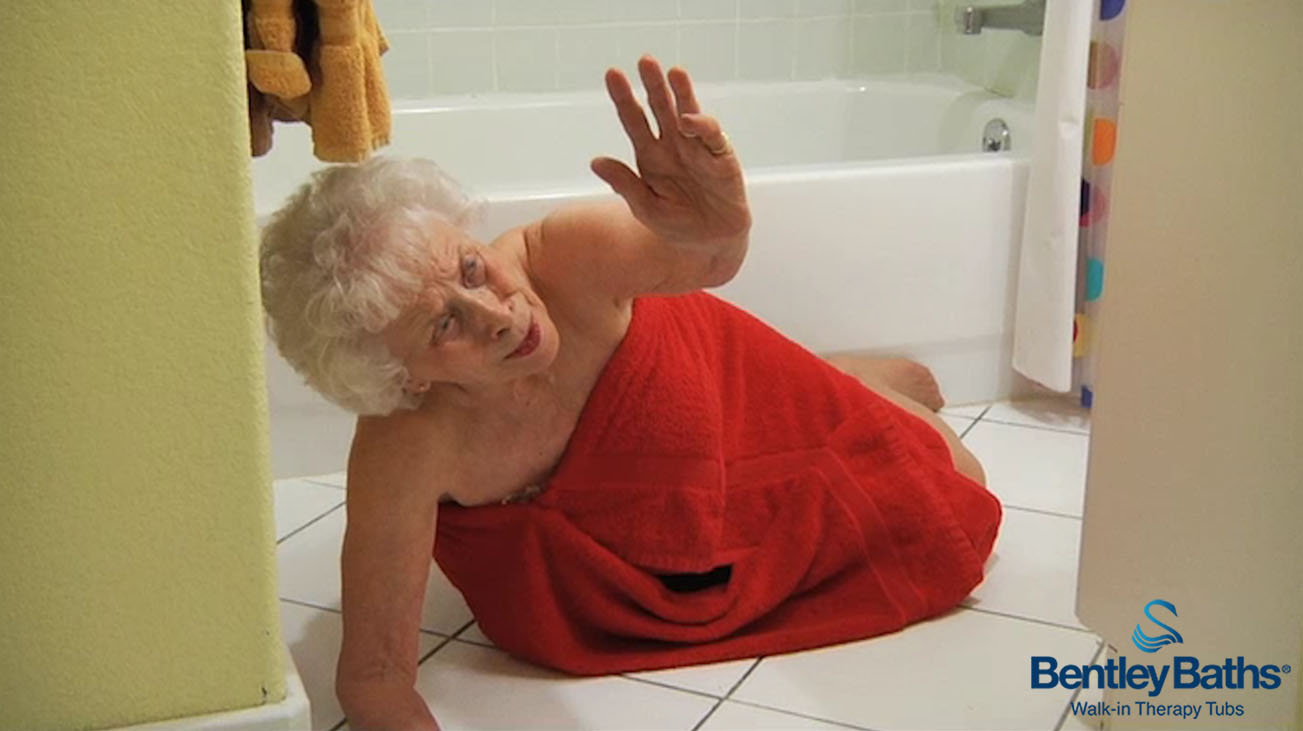 It is not uncommon for me to watch a senior struggle to analyze, with much stress and difficulty, how they’re going to enter that bathtub. Many will stand outside the tub at the wall in the bathroom opposite where the valves are, face away from the valves, lean both hands against the wall to brace themselves, and then start the painful process of trying to lift first one leg, then the other, over and into the bathtub in order to transition in.
Many can’t even begin to lift their leg to make this process. Those who do accomplish getting into the tub using this method are now facing the wrong direction in the tub and standing up, rather than sitting. We then watch them slowly turn themselves around, orient themselves in the tub, and then begin the process of lowering themselves onto the floor so that they can bathe (see the video of Mr. Diass on the Bentley Baths YouTube Channel). Scary to watch.
It’s also not uncommon for me to look at a spouse or an adult child at this point and inquire: “Are you seeing this? Can you see how dangerous this process is for your wife, mom or dad?” Fact is, getting into the bathtub or shower will be one of the most dangerous things a senior will go through on any given day, week, or month. Fact is, with the inclusion of going up or down stairs, nothing is more dangerous. Others can’t even begin the process of trying to step into the tub. They will sometimes lie on the floor on all fours and attempt to throw one arm and one leg over into the tub and slide over the top edge of the bathtub in order to get into the bath itself. Once in the tub, they are, once again, usually facing the wrong direction. They have to go through the very stressful, strenuous process of trying to move their legs under their body, and turn themselves around to get situated in the bathtub.
Observing this process first hand in hundreds of homes led me to conclude that “millions of seniors are suffering quietly in the bathroom!” This is exactly what my mom went through. I now understand how millions and millions of seniors are forced to determine for themselves how it is that they are going to attempt to get their aged, weak, unstable bodies into (and hopefully out of) that bathtub. The process of entering a bathtub or shower becomes very, very difficult and many people are unwilling to acknowledge and accept this. But the obvious issue is that once I am in a bathing environment that is designed for me to lie on the floor in order to take a bath, it is only a matter of time until I will not be able to get myself back up off the floor and out of that bathtub. That is exactly how many of the people I interviewed injured themselves. They were able to get themselves into the tub, and were able to get down on the floor to take their bath. However, after finishing the bath, they required great exertion and use of all their strength to try to get themselves up. In this wet slick environment, they slip or lose their balance, thus falling out of (or into) the bathtub.
Think the Shower is Safer? Think Again.
One thing that I encounter in my conversations with seniors is that many believe that showers are actually safer. Men in particular tend to suggest that because they often shower instead of bathing, and that by doing so they are somehow perfectly safe.
 I wish that were true! But it’s not. Showers, even if they have low barriers, are actually more dangerous than bathtubs. Yes, it may be somewhat easier to get my feet over the threshold of a three, four or five-inch shower pan than it is an eighteen, twenty or thirty-inch-high bathtub sidewall. Showers are designed and engineered in such a way that the bather must stand while they wash themselves. This requires that you have sufficient stability and balance so as to easily reach all your body parts from a standing position. Inserting a stool or bench into the shower means not having to stand, but the lack of stability is unchanged. Now both the person and the stool are unstable.
One becomes more vulnerable to fall-related injuries when moving in and out of a shower. Wet surfaces, hard surfaces, glass shower doors, moveable shower curtains, standing and moving, light-headedness or dizziness, are all factors that lead to a situation where showers are more dangerous than bathtubs. I refer to this as doing the “rain dance.” It is simply NOT safe!
We are standing, unsupported and transitioning in or out in an environment that is unforgiving. The mere fact we are in a standing position means our fall related injury risk is exponentially greater than when we are seated. The issue with bathtubs is getting into and out of them. That’s dangerous, but at least while you’re lying in the tub you’re stable. In a shower, you are unstable and at risk throughout that entire process.
So why do we do this? Why do we go through all these gyrations and put ourselves at such risk?
Speaking for my family, we simply did not know that there were resources available to help make that bathroom safer for my mom. My mom simply did not know that there were measures we could take that would make that bathroom significantly safer for her. We did understand that the engineering and technology and grab bars were available, and we did in fact put a couple of grab bars in the bathtub for her, but we had no idea as to whether those were sufficient, whether they were placed properly, and also, most importantly, whether they would in fact make my mom safe.
As it turned out, our limited efforts, based on limited information, did not make her safe.
The Hunt for Safe Technologies
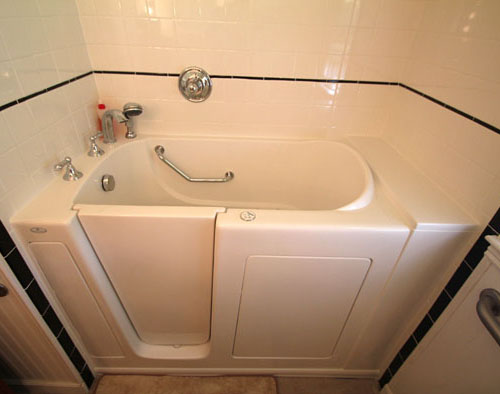 When I first began conducting interviews for this blog post, I asked occupational therapists, physical therapists, rehab specialists, visiting nurses, in-home care nurses, orthopedic surgeons — anybody I could talk to! — about bathroom safety, and how we could make bathrooms safer for seniors and those with mobility challenges. Not one of them ever mentioned to me the fact that there are safe bathing technologies, walk-in bathtubs or transition tubs that could be installed to make bathrooms much more accommodating. It was not until after my mom had passed and my father was facing a double hip replacement that I began to research further. As I related earlier, my father was told that after the double hip replacement it was possible he would not be able to live independently anymore. The doctor calmly told him that he possibly wouldn’t be able to get around without a walker, might not be able to drive, and possibly wouldn’t be able to live independently in his home. The doctor matter-of-factly encouraged Dad to plan for those outcomes. Like many other seniors faced with potential restrictions to their activities of daily living (ADLs), what my father heard was not “possibly,” but “definitely”—he was going to be forced into a nursing home. This devastated him, and he called me to defiantly pronounce that he would never willingly go into a nursing home. His reaction was based on the fact that he had been traumatized by what had happened to my mom. He had seen firsthand the physical, emotional, and financial toll of her injury and his role as primary caregiver. His quality of life had been terrible. He was helpless to save Mom from her misery in that nursing home, and was adamant that he did not intend to follow her into that situation. At the same time, he made it equally clear that he had no intention of moving in with either me or my sister. His blunt conclusion: “I intend to stay in this home. I do not want to move anywhere. When my soul leaves this earth, I want my body to go through that front door, and it is your job, George, to help me make sure that happens!” Well, obviously, I got it. It made perfect sense to me that this is what my dad wanted, and it makes perfect sense that I’m going to want the same thing for myself. He lives in the home my mother was born in. He raised his family there. His church is a half a block down the street. His hometown, his friends, his familiar life patterns, his memories—all are right there in that house. So I busied myself trying to figure out how to keep my dad safe at home. In the process, I began to discover knowledge that I never knew existed. I didn’t know about walk-in bathtubs, transition tubs, or safe bathing appliances prior to doing the research in order to help my father out. I didn’t know that the bathroom was inherently dangerous and that I could have prevented my mom’s injury. So many of us are in the dark, not aware of the technologies that can enable us to live safely and independently in our own homes for life.
Stay tuned for the next installment of our blog, in which I talk about how the process of denial stops us from making the right decisions for ourselves and our loved ones, particularly where safe bathing technologies are concerned.