
Table of Contents
- ADA Compliance Grab Bars: What the Standards Actually Require
- ADA Shower Grab Bar Placement, Wall by Wall
- ADA Grab Bar Diameter, Length, and Clearance
- Toilet and Bathtub Grab Bar Locations
- Shower Grab Bar Installation: What Holds the Weight
- Are Suction Grab Bars ADA Compliant?
- ADA Standards vs. Private Homes: What Applies to You
- Frequently Asked Questions
Last Updated: October 14, 2026
ADA Compliance Grab Bars: What the Standards Actually Require
I have spent more than twenty years crawling around bathrooms, and the most misunderstood document in this business is the ADA Standards for Accessible Design. People quote it at me constantly, usually wrong, usually to justify a grab bar mounted in the wrong place.
At Bentley Baths, we have evaluated thousands of bathrooms, and the pattern is always the same.
Here is what most guides get wrong: they treat ADA compliance grab bars as a single checklist. The requirements change by fixture.
The 2010 ADA Standards for Accessible Design is the primary source here. If you only read one document after this article, read that one.
ADA Shower Grab Bar Placement, Wall by Wall
ADA shower grab bar placement follows simple logic: the bar goes where a seated or standing person needs to steady themselves, at the entry, at the controls, and along the back wall.
For a standard transfer shower: a horizontal grab bar on the back wall, at least 36 inches long, mounted 33 to 36 inches above the finished floor, measured to the centerline of the gripping surface.
The 36-inch minimum matters more than people realize. A 24-inch bar looks proportionate on a wall and fails the standard outright.
The most common mistake I see is mounting a grab bar to drywall with plastic anchors. That bar will hold a towel. It will not hold a falling adult. The consequence is not a repair bill, it is a hospital visit.
Transfer Showers and Roll-In Showers
A transfer shower is 36 by 36 inches with a seat and a 36-inch minimum opening, requiring bars on the back wall and control end wall. A roll-in shower has no curb, allows direct wheelchair entry, and typically requires a horizontal bar on the back wall plus a vertical bar at the entry.
If you are deciding between the two, the transfer shower usually fits a home where someone can still stand and pivot. The roll-in is for someone who stays seated.
ADA Grab Bar Diameter, Length, and Clearance
ADA grab bar diameter must fall between 1.25 and 1.5 inches. That range exists because a hand needs to close around the bar, and too thick or too thin defeats the purpose.
Three dimensions control whether a bar is usable:
- Diameter: 1.25 to 1.5 inches, measured on the gripping surface
- Wall clearance: 1.5 inches between the bar and the wall
- Mounting height: 33 to 36 inches above the finished floor for horizontal bars
That 1.5-inch clearance lets knuckles clear the wall when someone pulls. Skip it and the bar becomes a knuckle-bruiser.
The gripping surface also has to be continuous. Decorative brackets that interrupt the bar create a spot where a wet hand slips.
Toilet and Bathtub Grab Bar Locations
Toilet grab bars follow a fixed layout.
Both bars mount 33 to 36 inches above the finished floor. The rear bar is centered on the water closet, which is where people get it wrong.
Bathtub grab bars are simpler. A horizontal bar goes on the back wall of the bathing fixture, and where a permanent seat is installed, a bar goes on the head end wall.
| Fixture | Bar Location | Minimum Length | Mounting Height |
|---|---|---|---|
| Water closet | Rear wall | 36 inches | 33 to 36 inches |
| Water closet | Side wall | 42 inches | 33 to 36 inches |
| Bathtub | Back wall | 24 inches | 33 to 36 inches |
| Transfer shower | Back wall | 36 inches | 33 to 36 inches |
| Transfer shower | Control end wall | 18 inches vertical | 39 to 41 inches |
Measure to the centerline of the gripping surface, not the top or bottom edge of the bar. That single detail is where most do-it-yourself installs fail inspection.
Shower Grab Bar Installation: What Holds the Weight
Shower grab bar installation is a structural question, not a hardware question. The standard requires a grab bar to withstand a 250-pound load applied at any point and in any direction.
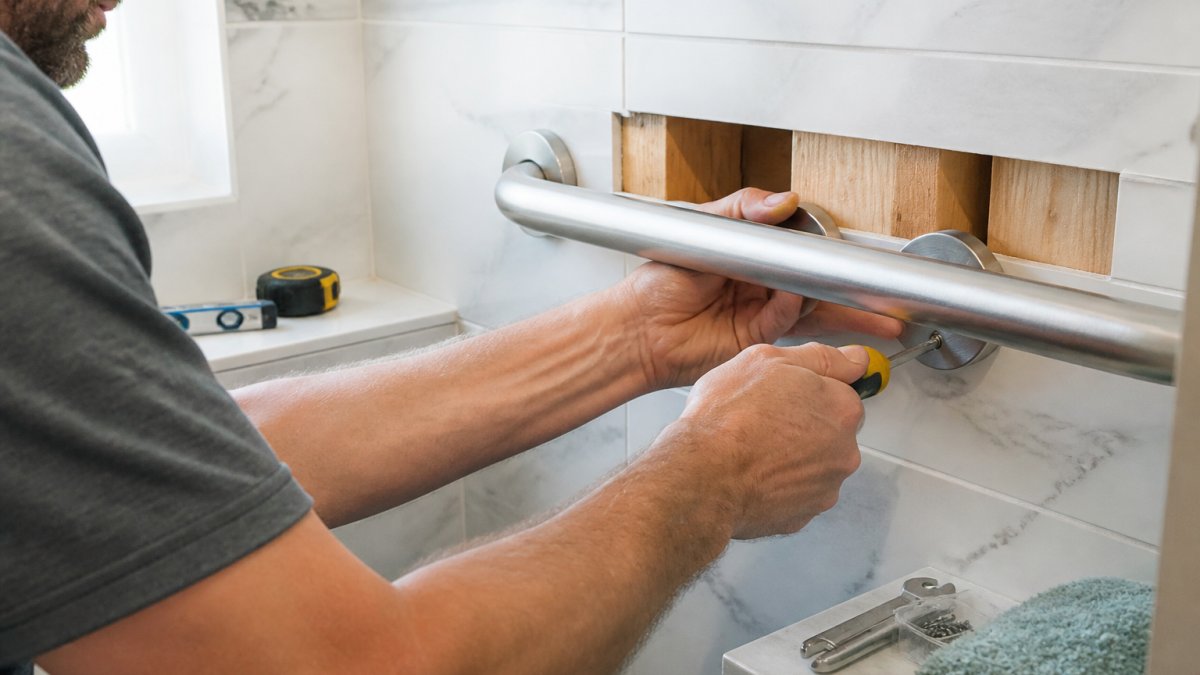
Here is the part most guides skip. The 250-pound requirement does not apply to the bar. It applies to the installed assembly. The bar, fasteners, blocking, framing, and wall all have to work together.
What has to be behind the wall
The load has to travel somewhere. In a wood-framed wall, that means solid wood blocking between the studs, or direct fastening into a stud where the layout allows.
In a remodel, we install blocking before the tile goes up.
Tile alone will not hold. Neither will the fiberglass shell of a prefabricated unit, unless the manufacturer specified reinforcement points. Many modern shower surrounds have those points molded in, and the documentation tells you where.
How anchoring actually works
A grab bar flange is only as strong as what it is fastened to. Three things matter.
First, the fastener type. Into solid wood blocking, lag screws or heavy structural screws are standard.
Second, the number and spacing of fasteners. Every flange hole gets a fastener. Not most of them.
Third, the depth of engagement. A screw that only catches the surface of the blocking is not engaged.
How to verify the installation after it is done
This is the step almost nobody does, and the one I recommend most. Once the bar is installed, before you trust it, do this.
Grab the bar with both hands and pull straight down with steady, increasing force. Not a jerk.
Then push up, push in toward the wall, and pull out away from it.
If you feel movement, stop. Do not use the bar.
The measurement check
While you have the tape measure out, verify the three dimensions that matter most.
- Centerline of the gripping surface at 33 to 36 inches above the finished floor for horizontal bars
- 1.5 inches of clearance between the bar and the wall
- Gripping surface diameter between 1.25 and 1.5 inches
Measure to the centerline, not the top or bottom edge of the bar. That single detail is where most do-it-yourself installs fail inspection.
Why I push blocking before tile
This is where I part company with a lot of online advice. People treat grab bar installation as a weekend project. Done correctly, it is a small construction job. Done incorrectly, it is a liability sitting on your wall waiting for the wrong moment.
If you are already planning a bathroom project, do the blocking now, before the walls close up. It costs almost nothing at that stage and a great deal later.
A grab bar that moves when you pull on it is not a grab bar. It is a decoration with a false sense of security attached. If it flexes, stop using it and find out why.
Test the installed assembly in every direction before you rely on it. The bar is rated. The wall is not. The assembly is what catches you.
Are Suction Grab Bars ADA Compliant?
No. Suction grab bars are not ADA compliant and never have been. The standard requires a permanently mounted bar capable of resisting a 250-pound load.
Does that mean suction grab bars are useless? Not entirely.
I have had this conversation more times than I can count.
If you want a bar you can trust, it has to be screwed into structure. There is no shortcut.
A towel bar is not a grab bar. I have seen more bathrooms than I care to count where the only thing to hold onto is a towel bar that came with the house. It was never designed to take your weight, and it will not.
ADA Standards vs. Private Homes: What Applies to You
Here is the distinction that clears up most of the confusion, and the one almost every guide online skips: the ADA Standards apply to places of public accommodation and commercial facilities.
That is the legal answer. It is not the useful answer.
Let me unpack both, because I have watched people waste real money on the wrong assumption in each direction.
What the ADA actually covers
The Americans with Disabilities Act is a civil rights law.
So when a homeowner asks whether their bathroom has to be ADA compliant, the honest answer is no. No inspector will cite you. No fine.
That is where a lot of online advice goes wrong. It either implies every home must meet the ADA, which is false, or dismisses the standards as irrelevant to homeowners, which is worse.
Why the standards still matter in a private home
The ADA dimensions were not invented in a conference room. They were developed and refined against how people with limited grip strength, balance, range of motion, or a wheelchair actually use a bathroom.
When I design a bathroom for a homeowner, I follow the ADA dimensions not because an inspector will cite me, but because they are the best available guide to a bathroom that works.
The decision rule I give clients
Here is how I frame it. Ask two questions.
First: is this a residence or a public accommodation? If a residence, the ADA is a design guide, not a legal mandate.
Second: if this is a residence, do I want to meet the standard or beat it? Meeting it gets you a bathroom that works for most people most of the time.
That second question is where the real design work happens. The ADA sets a floor, not a ceiling.
Where the exceptions live
The standards do contain exceptions and alternatives, and they matter most in existing buildings and certain fixture types.
If you are dealing with a commercial property, those exceptions are not optional reading. They are the difference between a compliant project and a failed inspection.
The 2010 ADA Standards for Accessible Design is the primary source. The ADA National Network’s guidance on accessible bathing is a useful plain-language companion when the code language gets dense.
The trap I see homeowners fall into
A homeowner reads a commercial compliance guide, assumes it applies to their house, and either overbuilds or gets paralyzed.
Both are avoidable. The law is narrow. The design guidance is broad and useful. Keep them separate in your head and the whole subject gets simpler.
If you are in the Denver area and want someone to look at your actual bathroom rather than a diagram, that is what our free safety assessment is for.
Frequently Asked Questions
What is the diameter of an ADA compliant grab bar?
The ADA Standards set the gripping surface between 1.25 and 1.5 inches in diameter, with a clearance of 1.5 inches between the bar and the wall. Every ADA grab bar follows the same rules, whether it is a shower, toilet, or bathtub bar. A bar outside that range can be hard to grip, especially for someone with arthritis or limited hand strength, so check the spec sheet before you buy.
Are vertical grab bars covered by ADA guidelines?
Yes, but where they are required depends on the fixture. In a standard transfer shower, the standards call for a vertical grab bar on the control end wall, and the dimensions are spelled out in the ADA Standards. In a residential bathroom, a vertical bar is a practical addition even when no rule requires it, because it gives you something to hold while you step over a tub apron or lower yourself onto a seat.
Are suction grab bars ADA compliant?
No. Suction grab bars are not ADA compliant and should not be treated as a permanent safety device. The standards require wall-mounted bars anchored into structural support and able to resist a 250-pound load. A suction cup depends on an airtight seal against a smooth surface, and that seal can fail without warning. They can be useful for travel or a temporary stay, but for daily bathing safety, use anchored bars.
How much weight should an ADA compliant grab bar support?
The ADA Standards require grab bars to withstand a 250-pound concentrated load applied at any point and in any direction. That number is a minimum for the bar and its anchoring, not a weight limit for the person using it. A bar anchored into blocking or a stud with proper fasteners passes that test. A bar screwed into drywall alone does not, no matter how sturdy it feels when you tug on it in the store.
Can a grab bar be installed on any shower wall?
Not reliably. The bar is only as strong as what it is anchored to, so the wall behind it matters more than the bar itself. Fiberglass surrounds and tile over drywall often have no blocking where you need it, which means the installer has to add support before the bar goes up. That is why I tell people to have the wall opened and inspected rather than guessing. A grab bar that pulls out of the wall is worse than no bar at all.
Do ADA grab bar requirements apply to private homes?
The ADA Standards apply to places of public accommodation and commercial facilities, not to private residences. A single-family home is not covered. That said, the dimensions in the standards are a sensible starting point for any bathroom, because they were developed around real bodies and real reach ranges. For a home, think of them as good guidance rather than a legal obligation, and adjust to the person who actually uses the bathroom.