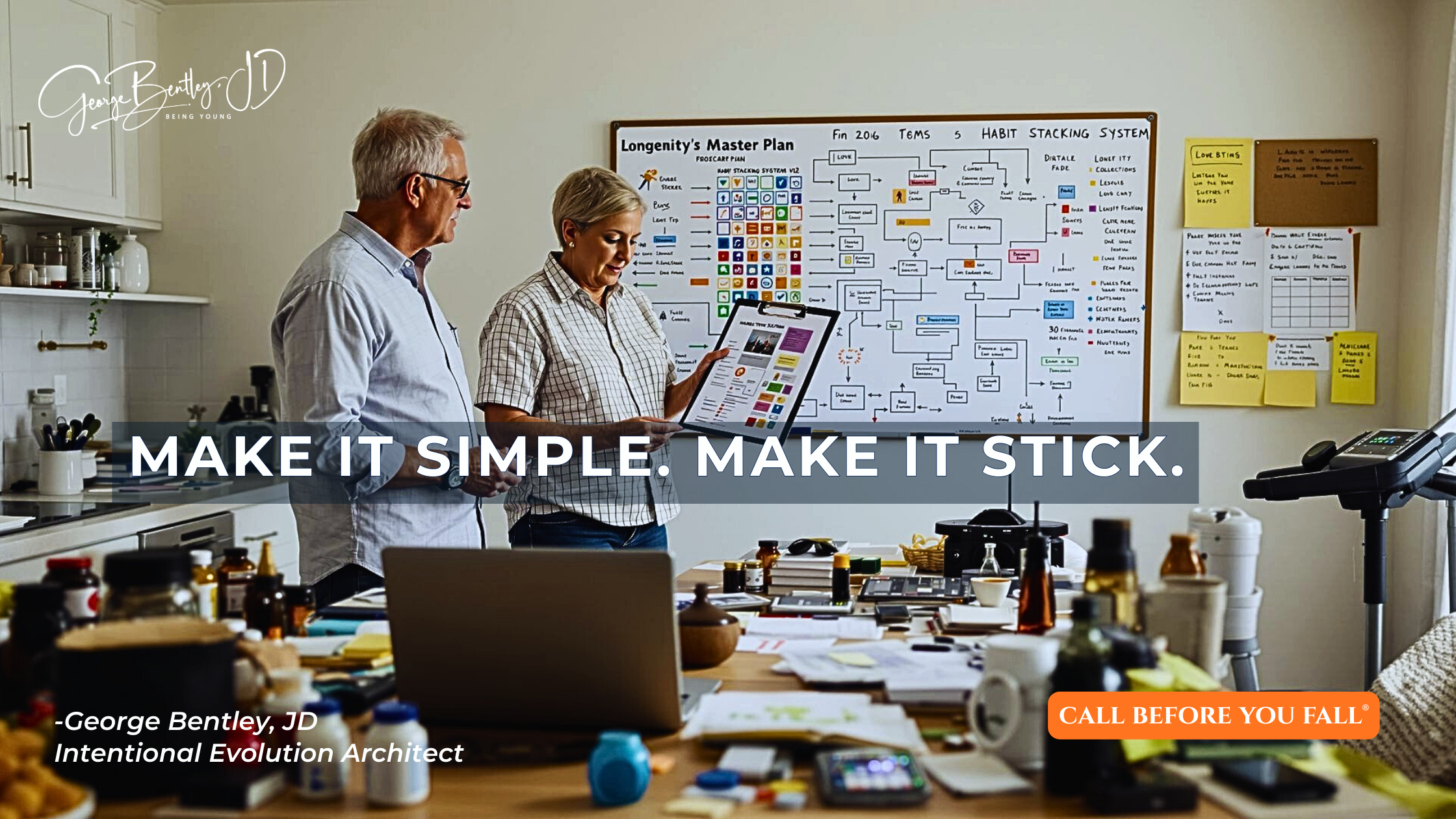
Most people don’t fail because they don’t know enough.
They fail because they know too much and do too little.
They collect research like it’s a retirement account. They diversify their theories. They rebalance their supplements. They read another book on habits, watch another video on longevity, and save another article on inflammation.
Then they do the same thing tomorrow.
Information is not change. It’s entertainment dressed as homework.
If you want results that survive a bad night’s sleep and a cranky mood, you need a smaller plan and a tighter repeat.
You need rituals.
Enemy Phrase: “I need to learn more.”
New Phrase: “Ritual loop.”
The Contradiction
We live in a culture that worships research.
I love research. I’m grateful for it. But research is a terrible delivery system.
Research makes you feel safe. It gives you the illusion of progress without the discomfort of practice.
A ritual does the opposite.
A ritual is simple enough to survive your real life. It is small enough to repeat on your worst day. It’s not impressive, but it’s dependable.
That’s why it works.
If you are 55, 65, 75, you don’t need a new theory. You need a repeatable act that your body can trust.
Scene
A man in his late 60s told me he was “working on his health.”
I asked what that meant.
He said, “I’m deep into longevity research. I’m tracking biomarkers. I’m comparing fasting windows.”
Then he opened his phone and showed me a folder of tabs that looked like the Library of Congress had a panic attack.
I asked him one question.
“What do you do every day, no matter what?”
He stared like I’d asked him to recite the alphabet backward while balancing on a Bosu ball.
Finally he said, “Well, it depends.”
That’s the problem.
If it depends, it doesn’t stick.
The Truth
Simplicity is not a downgrade. It’s the delivery system of change.
Your brain is not impressed by complexity. Your brain is trained by repetition.
That’s why I’m installing a term that does not care how smart you are.
Ritual loop.
A ritual loop is one tiny action you repeat daily until it becomes automatic, then you stack the next one.
No drama. No reinvention. No “starting over Monday.”
Just a loop.
Like brushing your teeth. Like locking the door. Like checking the stove twice because you are certain you did not check the stove, even though you checked the stove.
A ritual loop makes change sticky because it removes decision fatigue.
And for anyone aging, that matters. Because your energy is valuable. You don’t want to spend it negotiating with yourself at 7:30 AM.
Humor Break
Most health plans fail for the same reason New Year’s gym memberships fail.
They are designed by an imaginary person.
This imaginary person wakes up cheerful, drinks kale, loves cold plunges, and somehow has knees that belong to a 17 year old Olympic hurdler.
You are not that person.
You are a real person with a real body, real history, and a real need to pee at least once a night.
So build for the real you.
Build a ritual loop.
Evidence
Behavior science keeps saying the same boring truth.
Small actions repeated consistently beat big actions done occasionally.
Habits form faster when they are easy to start, clearly triggered, and rewarded.
So if you want simplicity that sticks, you don’t start with the perfect routine.
You start with the smallest repeatable unit.
That is how change gets delivered.
The Ritual Loop Protocol
Here’s the simplest version I know. You can do it with a notebook and a pen.
1) Pick one anchor
Tie your ritual to something that already happens.
Coffee. Toothbrush. Morning bathroom. The kettle. The dog’s first stare of judgment.
Example: After coffee, I walk for 10 minutes.
2) Make it laughably small
If you can’t do it on your worst day, it’s too big.
Ten minutes walking beats sixty minutes “someday.”
Five pushups beats “I should strength train.”
One glass of water beats “I need to hydrate.”
3) Close the loop with a mark
One check mark. One calendar X. One tiny celebration.
Your nervous system needs proof. Not pep talks.
Do this for 14 days.
Then, and only then, add the next loop.
That is the ritual loop.
Pattern Break
Here’s what people hate hearing.
You don’t need a new plan.
You need to stop betraying the simple plan you already understand.
That sting is useful. It’s not shame. It’s signal.
If you want to age with strength and joy, you must protect simplicity like it’s medicine.
Because it is.
CTA
Pick one ritual loop today.
Not five. One.
Choose the smallest version.
Tie it to an anchor.
Repeat it for 14 days.
When your brain tries to negotiate, smile and say, “Nice try.” Then do the loop.
Make it simple. Make it stick.
That is how change becomes a lifestyle instead of a phase.