
Table of Contents
- Walk-In Tub Installation Cost Breakdown: What You Are Actually Paying For
- Walk-In Tub Installation Requirements That Drive the Price
- Hidden Costs of Walk-In Tub Installation Most Quotes Leave Out
- Does Medicare Cover Walk-In Tubs?
- What Separates a Cheap Install from a Safe One
- Questions to Ask Before You Sign Anything
- Conclusion: Diagnosis Before Purchase
- Frequently Asked Questions
Last Updated: October 16, 2026
Walk-In Tub Installation Cost Breakdown: What You Are Actually Paying For
Before you compare a single number, answer one question: what is that number actually buying, and where does a walk in tub installation cost breakdown say the money goes?
A walk-in tub installation cost breakdown is the itemized accounting of everything a project requires, the tub itself, the labor, the electrical work, the door clearance, the subfloor prep, the disposal, the permits, and the finish work, rather than one lump figure quoted at the kitchen table. At Bentley Baths, I have walked into thousands of bathrooms since 2003, and I can tell you the lump figure is usually the least informative part of the conversation.
Here is the uncomfortable truth. Two homeowners can be quoted the same amount and receive wildly different work. One gets a tub dropped into an unchanged alcove. The other gets a properly supported, correctly wired, code-compliant installation that will still be safe in fifteen years.
Only one of those is a bargain.
Below, I will walk through the real cost drivers, the line items that vanish from cheerful estimates, and the questions that separate a careful installer from a fast one. For Denver-area Bentley Baths projects, most walk-in tub projects are approximately $15,000 to $18,000 installed, unless unusual construction changes the scope. That figure is ours and ours alone. Anyone else’s number is theirs to explain.
The most expensive walk-in tub is the one installed wrong the first time. A tub that leaks into a subfloor, trips a breaker, or sits on unsupported joists costs far more to correct than it ever saved up front.
Walk-In Tub Installation Requirements That Drive the Price
Price is set by what your bathroom needs, not by what the brochure says. A walk-in tub installation almost never fits the exact footprint of the tub it replaces, and the gap between “almost” and “actually” is where the money lives.
The tub is only part of the project. The rest is what has to change around it.
Door Swing and Clearance
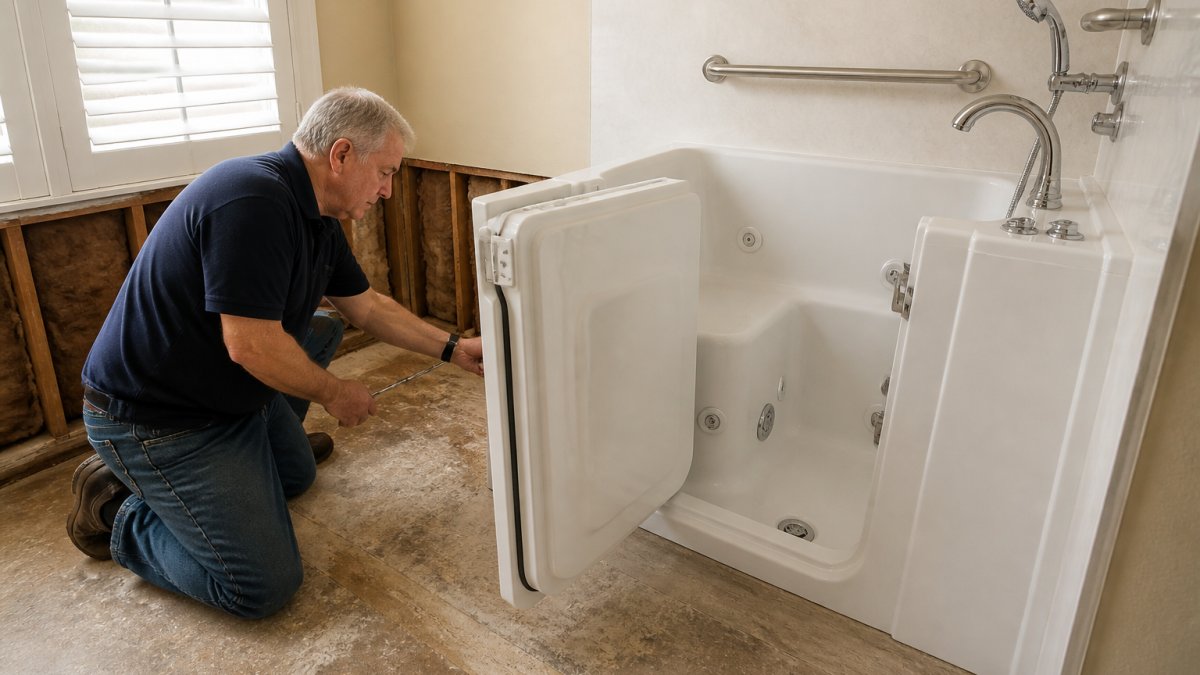
An inward-swinging door needs open floor space in front of it, and that space is often occupied by a toilet, a vanity, or a towel bar pretending to be a grab bar. If the door cannot open fully and safely, the layout has to change before the tub goes in. Moving a vanity or rehanging a door is real labor, and it belongs in the quote.
Electrical and Water Supply
Most walk-in tubs use a pump, an inline heater, or both, which means a dedicated circuit, a GFCI outlet, and often a new run back to the panel. Older bathrooms frequently have no spare capacity. If your panel is full or your wiring is dated, that is a licensed electrician’s line item, not a favor from the installer. Water supply lines and drain locations may also need to shift to match the new tub’s plumbing configuration.
Floor Support and Subfloor Condition
Water is heavy. A filled walk-in tub can place substantial concentrated load on the floor structure, and not every floor was framed with that in mind. Sometimes a joist needs sistering or a support is added below. Sometimes the subfloor under the old tub has been quietly rotting for years and nobody knew until it came out. You cannot price that until you look.
Ask the estimator to pull the access panel or look under the floor before quoting. An estimate given without inspecting the subfloor and the panel is a guess wearing a suit.
Hidden Costs of Walk-In Tub Installation Most Quotes Leave Out
The line items that disappear from a friendly estimate are the ones that reappear on your final invoice. This is not always dishonesty. Sometimes it is just a salesperson who never asked.
Either way, you pay for it.
Permits, Disposal, and Site Prep
Electrical and plumbing changes typically require permits and inspection in most jurisdictions, and the fee structure varies by city and county. Ask who pulls the permit and who pays for it. Then ask who hauls away the old tub, protects your flooring and hallway, and repairs drywall and paint after the work. Removal and disposal alone can be a meaningful line item, and it is frequently omitted because it is unglamorous.
Warranty Gaps and Change Orders
Here is the one that stings. A manufacturer’s warranty on the tub does not cover the labor to remove and reinstall it if something fails. Ask specifically about the labor warranty, its length, and who honors it. Then get the change-order process in writing. If the subfloor is soft or the wiring is non-compliant, what happens to the price, and who decides?
| Cost Driver | What It Covers | Why It Gets Omitted |
|---|---|---|
| Door clearance | Layout changes, door rehang | Assumed to fit |
| Electrical | Dedicated circuit, GFCI, panel work | Not inspected up front |
| Subfloor | Joist support, rot repair | Hidden until demolition |
| Permits | Filing and inspection fees | Varies by jurisdiction |
| Disposal and site prep | Haul-away, floor and wall protection | Unglamorous |
| Labor warranty | Service calls after install | Rarely discussed |
Does Medicare Cover Walk-In Tubs?
No. Original Medicare does not cover walk-in tubs, because a tub is considered a home modification rather than durable medical equipment. Medicare Part B covers durable medical equipment that is medically necessary, and a walk-in tub does not meet that definition.
That answer frustrates people, and I understand why. So let me be precise about what does exist. Some Medicare Advantage plans offer supplemental benefits that can include home safety modifications, and those benefits vary widely by plan and by year. Medicaid waiver programs in some states may cover certain accessibility modifications for eligible beneficiaries. Veterans may find assistance through VA programs, and long-term care insurance policies sometimes include home modification benefits.
I am deliberately not quoting dollar figures or eligibility thresholds here, because those change and they are set by the programs themselves. Check your own plan documents, your state Medicaid office, or your VA benefits counselor directly. Anyone who tells you a specific reimbursement amount without looking at your actual policy is guessing.
What Separates a Cheap Install from a Safe One
A cheap installation saves money on the parts you cannot see. That is the whole difference, and it is nearly invisible until it fails.
Safe installation means the tub sits on structure that can carry it, the electrical work is permitted and inspected, the door seals properly, and the grab surfaces are anchored into framing rather than drywall. It means the installer measured your doorway, your hallway, and your turn radius before the truck arrived.
The ADA Standards for Accessible Design give useful guidance on clear floor space and grab bar placement, and they are worth reading even for a private home, because they reflect decades of accumulated knowledge about how people actually fall. The CDC’s older adult fall prevention resources make the same point from a public health angle: most falls happen in the bathroom, and most are preventable with the right environment.
What most guides miss is that the tub is not the safety device. The installation is.
A walk-in tub is a tool. The installation determines whether that tool works. Budget for the installation as seriously as you budget for the tub.
Questions to Ask Before You Sign Anything
Bring this list. Write the answers down. A company that resists written answers is telling you something.
- Who pulls the permit, and is the fee included?
- Is the electrical work done by a licensed electrician?
- What happens if the subfloor needs repair? Who pays, and how is that priced?
- What is the labor warranty, how long does it last, and who honors it?
- Is the old tub removal and disposal included?
- Are there subcontractors involved, and who is accountable for their work?
- What is the change-order process in writing?
- Can I see the itemized scope, not just the total?
- What is the cancellation policy, and is there a cooling-off period?
If the salesman has to call his manager three times before midnight, somebody may be performing dinner theater in your bathroom. Real pricing does not require a countdown clock.
Conclusion: Diagnosis Before Purchase
The walk in tub installation cost breakdown you receive should read like a diagnosis, not a pitch. If it lists a tub and a total and nothing else, you have not been given a breakdown. You have been given a hope.
Here is the question I would leave you with: are you choosing the bathroom that works today, or the one you may need in two years?
At Bentley Baths, we start with a free safety assessment, an in-home or virtual evaluation by an age-in-place specialist. We look at your door swing, your panel, your subfloor, and how you actually move through the room. Then we tell you what makes sense, including when the answer is not a walk-in tub. You can also work through our Safe Bathing Course at your own pace before anyone visits your home.
You will talk with me, George Bentley, not a call center. Bring your questions. Bring your family. The goal is to figure out what actually makes sense for your bathroom, your body, and your next twenty years.
BentleyBaths.com | 800-688-0055 | George@GeorgeBentley.com
Frequently Asked Questions
What is the average cost to install a walk-in tub?
There is no single national average because the walk-in tub cost depends on the tub you choose, the condition of your bathroom, and what the installer actually includes. A quality installed project often lands in the mid five figures, but a low advertised price usually reflects a basic tub swap, not a complete safe-bathing solution. Ask every company for a written, itemized scope before you compare numbers.
Does Medicare cover the cost of a walk-in tub?
Original Medicare generally does not cover walk-in tubs because they are classified as home modifications, not durable medical equipment. Medicare Advantage plans may offer some flexibility, but coverage varies by plan. Always call your plan directly and ask for the specific benefit in writing. Some veterans benefits and state-based programs may also help, so check official sources for your situation.
Why is the installation cost of a walk-in tub so high?
Walk-in tub installation is not a simple swap. It often involves removing the old tub, checking the subfloor, running dedicated electrical for pumps and heaters, adjusting the water supply, and rebuilding the surround. The tub itself is only part of the number. Labor, permits, disposal, and finish work make up the rest. A quote that ignores those items is not a complete quote.
What hidden costs should I look for in a walk-in tub quote?
Watch for permit fees, old tub removal and disposal, subfloor repair, electrical upgrades, drywall and tile repair, and any change-order language that lets the price climb after the contract is signed. Ask whether the quote is a fixed price or an estimate, and get every inclusion in writing. If a salesperson will not put it on paper, treat it as a hidden cost.
How long does it take to install a walk-in tub?
Most standard installations take one to three days once the tub is on site, but that depends on the condition of the bathroom and whether electrical or plumbing work is needed. Custom sizes, floor repairs, or tile work can extend the timeline. Ask the installer for a written schedule and what happens if something unexpected is found behind the wall.
Is it cheaper to install a walk-in tub or a walk-in shower?
A walk-in shower is often less expensive upfront because it uses less material and simpler plumbing. A walk-in tub costs more but offers seated soaking, which some people need for pain relief or balance. The right choice depends on what is getting harder for you, not just the price tag. A free safety assessment can help you decide which one actually fits your bathroom and your body.