Table of Contents
- What Actually Matters When Choosing a Shower vs Bathtub for Senior Mobility
- Walk-in Tub vs Walk-in Shower: The Real Differences for Your Situation
- Accessible Shower Features for Seniors: What Actually Prevents Falls
- Shower Chair vs Tub Bench: Seating Solutions for Limited Mobility
- Medicare Coverage for Walk-in Showers: What You Need to Know
- Bathing Independence and Caregiver Assistance: How to Plan for Both
- Making Your Decision: Mobility Level, Space, and Long-Term Needs
- What Comes Next: Getting the Right Assessment and Installation
- Frequently Asked Questions
Last Updated: October 19, 2026
What Actually Matters When Choosing a Shower vs Bathtub for Senior Mobility
Your bathroom may look safe. That is not the same thing as being safe.
I’ve spent decades helping people figure out whether a walk-in shower or a walk-in tub makes sense.
Shower vs bathtub for senior mobility is not a simple either-or choice. It depends on your limitations, your layout, and what you’re trying to accomplish over the next five to ten years.
The real decision is not about the product. It’s about what you need the bathroom to do.
Before you commit to any major remodel, ask yourself:
- What is getting harder right now?
- Are you choosing the bathroom that works today, or the one you may need later?
- What would staying independent at home be worth to you?
At Bentley Baths, we start every conversation with diagnosis, not sales. Let’s walk through the actual differences so you can make a decision that makes sense.
Walk-in Tub vs Walk-in Shower: The Real Differences for Your Situation
A walk-in tub has a door. You step in, sit down, close the door, and fill the tub. A walk-in shower has no tub.
The core difference is not water pressure or style. It’s how you move and what your body needs.
Walk-in tubs work best when:
- You need to sit while bathing (easier on balance and joints)
- You want deep soaking for arthritis, circulation, or muscle tension
- You have limited leg strength and stepping over a tub rim feels risky
- You want a gradual entry (water level rises as the tub fills)
- You prefer not to stand for the entire bathing process
Walk-in showers work best when:
- You can stand safely with grab bars for support
- You move quickly and don’t want to wait for filling and draining
- You have limited space in your bathroom
- You prefer standing showers and want easier access than a traditional tub
- You need a roll-in option for a wheelchair or walker
The trade-off is real. A tub takes eight to twelve minutes to fill and another six to ten to drain. A shower is faster. But a tub lets you soak and let warm water ease joint pain. A shower gets you clean quickly but requires standing balance.
Neither prevents falls by itself. That depends on what you install inside it.
Accessible Shower Features for Seniors: What Actually Prevents Falls
Let me be direct: no shower, tub, or product can guarantee you won’t fall.
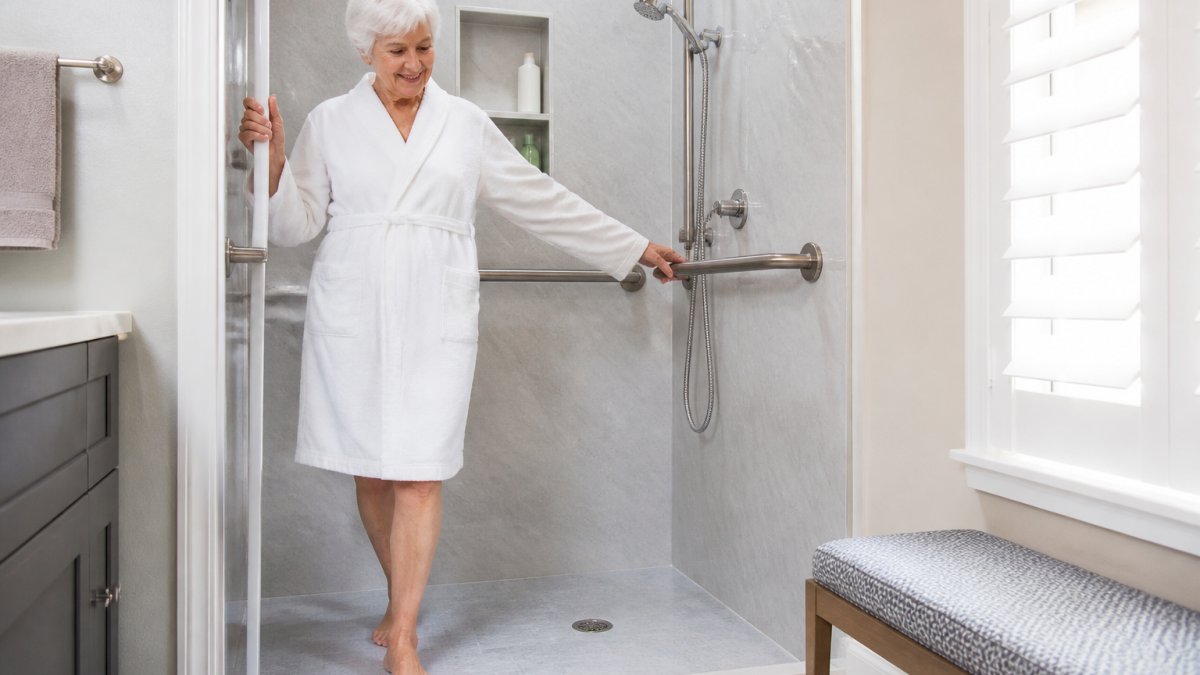
A truly accessible shower has four layers working together:
1. Entry and threshold
A curbless or near-zero-threshold entry means you step into the shower the same way you step into any room. No rim to step over. No trip hazard.
2. Slip-resistant flooring
The floor surface matters more than you think. Wet tile is slippery. Textured, high-grip surfaces reduce the chance your foot slides. This is not optional. This is foundational.
3. Grab bars in the right places
A grab bar is not a towel rack. It’s structural support rated to hold your full body weight.
4. Seating or a bench
If you can sit while showering, you eliminate the balance challenge of standing on a wet surface.
Threshold and Entry Height: Why This Matters More Than You Think
The height of the threshold is one of the most overlooked decisions in bathroom remodeling.
A traditional bathtub has a rim about 15 to 20 inches high.
A walk-in tub typically has a door that opens at a lower height than a traditional tub. You step in, not over. The difference feels small.
A curbless walk-in shower has zero threshold. You step into it the same way you step into a bedroom. No lift. No balance challenge. No negotiation.
If you are proactively planning for the future, a zero-threshold entry is the smartest long-term choice.
Grab Bars, Slip-Resistant Flooring, and Built-In Seating
These three elements work together. Leave one out and the other two do less work.
Grab bars need to be anchored to solid framing, not drywall, and be the right diameter (usually 1.25 to 1.5 inches) so your hand can grip firmly.
Slip-resistant flooring is basic safety, not a luxury. Textured surfaces, high-grip coatings, or specialty tiles reduce the chance your foot slides.
Built-in seating lets you shower sitting down, eliminating the balance challenge of standing on a wet floor. A bench built into the wall beats a portable chair because it does not move or take up floor space.
When comparing showers, ask the installer: “Where exactly are the grab bars anchored?” If they hesitate or say “in the framing,” ask to see the framing plan. Grab bars anchored to drywall are not grab bars. They are decorations that fail when you need them.
Shower Chair vs Tub Bench: Seating Solutions for Limited Mobility
If you are sitting while bathing, the surface you sit on matters.
A tub bench sits inside a traditional bathtub.
A shower chair is a portable seat in a walk-in shower. You sit while water falls from above.
The difference is comfort and time. A tub bench gives you twenty minutes of soaking in warm water.
For someone with arthritis, circulation issues, or muscle tension, soaking in warm water has real value.
A tub bench is built into the tub structure. A shower chair is portable and can be moved or removed.
Both require grab bars nearby so you can stand up safely when you are done.
Medicare Coverage for Walk-in Showers: What You Need to Know
Medicare may cover some bathroom modifications if they are deemed medically necessary and prescribed by a doctor.
The process is not simple. Your doctor must document that the modification is medically necessary for your specific condition.
Walk-in showers are more likely to be covered than walk-in tubs because showers are considered standard bathing equipment.
Coverage varies by plan and state. Some supplemental plans cover more. Some cover nothing.
The honest answer: call your Medicare plan directly and ask. Ask what documentation your doctor needs to provide. Ask what percentage they cover.
Do not assume Medicare will cover this. Many people assume it will and are disappointed.
Bathing Independence and Caregiver Assistance: How to Plan for Both
Some people bathe alone. Some people need a caregiver present. Most people want to bathe alone and need help getting in and out.
This changes which solution makes sense.
If you bathe alone, your priority is ease of entry, grab bars you can grip, and a non-slip surface. A walk-in tub or a walk-in shower both work.
If a caregiver helps you, the priority shifts. The caregiver needs to help you safely. This means:
- Wide enough space for two people
- Grab bars positioned so the caregiver can assist without getting in your way
- A bench or chair that is stable enough for a caregiver to help you sit and stand
- Clear sightlines so the caregiver can see you and respond if something goes wrong
A walk-in shower with a bench often works better for caregiver-assisted bathing because there is more floor space and the caregiver can stand beside you.
If you are planning for both independence and occasional caregiver help, design for the caregiver scenario. Independence is easier to achieve in a space designed for two people than the reverse.
If you need caregiver assistance, do not rely on grab bars alone. A caregiver should be able to help you safely without you gripping a bar. The bar is backup, not the primary support. A well-designed space lets the caregiver stabilize you with their body while you use grab bars for additional security.
Making Your Decision: Mobility Level, Space, and Long-Term Needs
Here is how I help people decide:
Start with mobility level.
- Can you stand safely for five to ten minutes with grab bars? A shower works.
- Do you need to sit while bathing? A tub or a shower with a bench.
- Do you use a walker or wheelchair? A roll-in shower with zero threshold and plenty of space.
- Is your mobility changing? Plan for the mobility level you will have in five years, not the one you have today.
Then consider space.
- How much floor space do you have? A shower takes less than a tub.
- Can you fit a tub and still move around safely? If not, a shower is the answer.
- Do you need room for a caregiver? Showers usually offer more space for two people.
Then ask about time.
- Do you want to soak? A tub. Want to shower quickly? A shower.
- Can you wait eight to twelve minutes for a tub to fill? If not, a shower is faster.
Finally, think long-term.
- Are you choosing the bathroom that works today, or the one you may need later?
- What is getting harder? Plan for that specific problem.
- What might get harder in five years? Build capacity for that now.
A walk-in shower with grab bars and a bench is the most flexible solution for most people. It works for independent and caregiver-assisted bathing, requires less space than a tub, is faster, and accommodates mobility changes.
A walk-in tub is the right choice if soaking matters to you, if you have serious balance issues, or if you want deep water for circulation and joint relief.
Some people need both: a small shower for daily use and a tub for therapeutic soaking. It is expensive and takes space, but if the space and budget allow, it solves multiple problems.
What Comes Next: Getting the Right Assessment and Installation
Before you spend money, get a real assessment.
This is not a sales call. This is a diagnosis.
At Bentley Baths, we offer a free safety assessment and can help you understand what your bathroom actually needs. We also offer a free Safe Bathing Course so you can learn the fundamentals of bathing safety and independence before making any decisions.
The goal is not to sell you a tub or a shower. It is to figure out what actually makes sense for you.
Once you decide, installation matters as much as the product. Grab bars need to be anchored to solid framing. Thresholds need to be level and slip-resistant. Seating needs to be stable.
Get everything in writing. Know what is included. Know what happens if something goes wrong. Know the timeline. Know the warranty.
Frequently Asked Questions
Which is better for senior mobility, a shower or a bathtub?
It depends on your specific mobility level and what’s becoming harder. Showers with curbless entry and grab bars are easier to step into and safer for balance issues. Walk-in tubs offer seated bathing and easier transfers for severe mobility limitations. Neither is universally ‘better’, the right choice matches your actual needs today and where you’re likely to be in two to three years. That’s why diagnosis comes before purchase.
What makes a shower easier to use for someone with limited mobility?
Accessible shower features for seniors include: low or zero threshold entry (no curb to step over), grab bars at correct heights, slip-resistant flooring, a handheld showerhead, and a built-in or portable shower chair. Good lighting and ventilation also matter. The goal is reducing the balance challenge of standing and the fall risk if you slip. A shower chair lets you sit while bathing, which changes everything for people with arthritis or weak legs.
Will Medicare pay for a walk-in shower for seniors?
Medicare coverage for bathroom modifications is limited. You should verify current eligibility with Medicare directly or speak with your doctor about what qualifies. Medicaid rules vary by state.
What’s the difference between a walk-in shower and a roll-in shower?
A walk-in shower has a low or zero threshold and grab bars, designed for people who can stand and walk but need safety features. A roll-in shower is fully wheelchair accessible, wide enough for a wheelchair to enter, with a completely flat floor and no threshold at all. If you use a wheelchair or walker and need to roll directly into the shower, you need a roll-in design. A walk-in shower works for people with limited mobility who can still stand and transfer independently or with minimal help.
Are you actually safe right now, or have you simply been lucky? If you are wondering whether a shower or tub makes sense for your situation, let’s figure it out together. You’ll talk with George himself. Bring your questions. Family members are welcome. The goal is to figure out what actually makes sense for staying independent at home.
Call 800-688-0055 or visit BentleyBaths.com to schedule your free assessment. You can also reach me at George@GeorgeBentley.com.