Table of Contents
- Roll-In Shower vs Walk-In Tub: The Core Differences
- Walk-In Tub Pros and Cons: What Sellers Often Skip
- Roll-In Shower for Wheelchair Access: What It Takes
- Accessible Shower Design: Features That Actually Matter
- Walk-In Tub Installation Considerations Before You Sign
- Space, Layout, and Cost: A Side-by-Side Comparison
- How to Decide: A Mobility-Based Framework
- Conclusion
- Frequently Asked Questions
Last Updated: October 18, 2026
Roll-In Shower vs Walk-In Tub: The Core Differences
Before I built my first accessible bathroom, I watched my mother negotiate a standard tub with a towel bar and a prayer. That towel bar holds towels. It did not secretly graduate from structural engineering school.
Here is the short answer to roll-in shower vs walk-in tub: a roll-in shower lets a wheelchair or walker roll straight in over a zero-threshold entry, while a walk-in tub requires a seated step-over and a door that seals behind you. That single difference in entry decides most of the comparison.
I founded Bentley Baths after my own mother’s fall, and I have spent decades helping families sort this exact question. Let me define the terms.
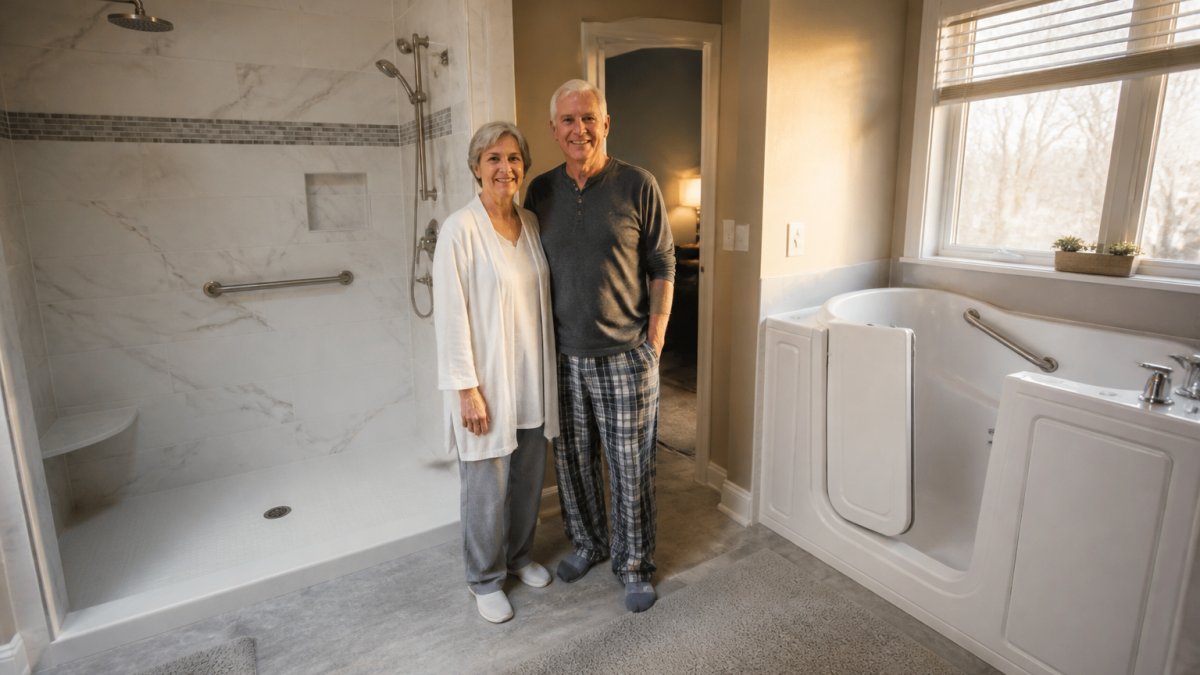
A roll-in shower has no curb or threshold, so a wheelchair rolls directly onto the shower floor. A walk-in tub has a hinged door and a low entry step, built for seated soaking rather than rolling entry. Neither is “better.” They solve different problems.
Walk-In Tub Pros and Cons: What Sellers Often Skip
Walk-in tubs are excellent at seated bathing, deep soaking, and a door you step through instead of a wall you climb over.
The pros most people already know:
- Seated soaking that is easier on hips and knees
- A low entry step compared with a traditional tub wall
- Built-in seats and grab bars on many models
- Warm water coverage for aching joints
The cons you will rarely hear on a sales call:
- Fill and drain time. You sit in the tub while it fills and empties. That is real time, every single bath.
- You still step over a threshold. A walk-in tub is not roll-in. A wheelchair user cannot roll into one.
- The door seal is a wear item. It needs care and eventual service.
- It is a bathing decision, not a transfer solution. If getting into the tub is the hard part, the tub alone may not fix it.
If someone in the household uses a wheelchair full time, a walk-in tub will not work as the primary bathing solution. The step-over threshold blocks rolling entry. Plan for a roll-in design instead, or a combination.
Roll-In Shower for Wheelchair Access: What It Takes
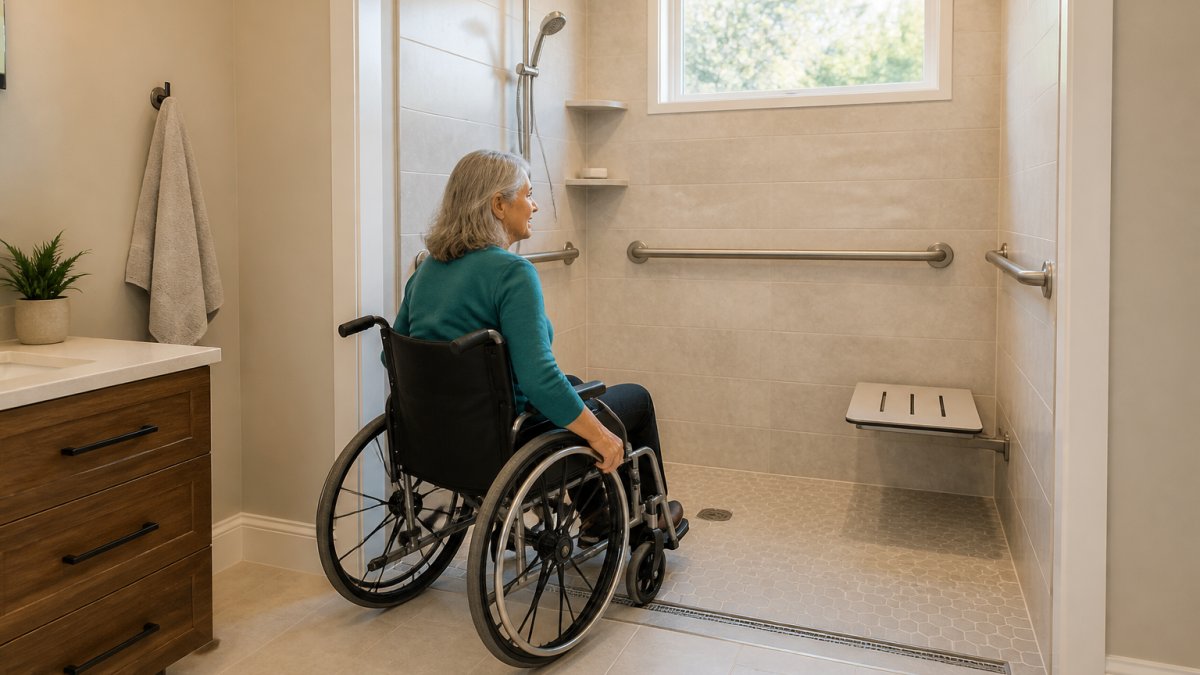
A roll-in shower is the only option here a wheelchair can enter without a transfer. That is its whole reason for existing.
What it takes to make one work:
- A true zero-threshold entry with proper waterproofing and drainage built into the floor
- Correct slope so water drains without pooling at the entry
- A fold-down or built-in seat for those who can transfer
- Horizontal and vertical grab bars placed for the actual user, not a generic template
- A handheld showerhead with accessible controls at seated height
- Non-slip flooring throughout the wet zone
Wheelchair accessibility is not a shower pan you drop in. It is a floor system. Get the drainage and waterproofing wrong and you will be repairing a ceiling below it.
Accessible Shower Design: Features That Actually Matter
Accessible shower design comes down to a handful of features that change daily life, and a long list that mostly changes the invoice.
What actually matters:
- Curbless entry or the lowest threshold the space allows
- Grab bars anchored into real blocking, not drywall
- A shower chair or built-in bench sized to the user
- A handheld showerhead on a slide bar
- Accessible controls reachable from a seated position
- Good lighting and a non-slip floor
What matters less than the brochure suggests: exotic finishes, six body sprays, and a rainfall head mounted so high you need a ladder to adjust it.
The bathroom layout has to serve the person, not the showroom.
Walk-In Tub Installation Considerations Before You Sign
Walk-in tub installation is where budgets and timelines go to die, and it is the part high-pressure salespeople gloss over.
Ask these questions before you sign anything:
- Who actually does the work? The company you bought from, or a subcontractor you have never met?
- What is the full scope? Removal, framing, waterproofing, electrical for jets, finish work, and haul-away.
- What is excluded? Get every exclusion in writing.
- What does the warranty cover, and for how long, and who honors it?
- What happens if the floor or framing needs repair once the old tub is out?
Ask for the installer’s name and license before the contract is signed, not the morning of installation. If the salesperson cannot answer that, you have learned something useful about the company.
Space, Layout, and Cost: A Side-by-Side Comparison
Space and layout often decide this before preference does. Here are actual numbers instead of adjectives.
A roll-in shower needs a footprint that can absorb a zero-threshold floor and proper drainage. Accessible design guidance calls for at least 30 inches by 60 inches of clear floor space inside the shower, with a seat and grab bars positioned for the actual user.
A walk-in tub needs a footprint that fits the tub plus clearance for the door to swing and for a person to stand and turn.
Here is the side-by-side on the things that actually bite:
| Factor | Roll-In Shower | Walk-In Tub |
|---|---|---|
| Entry | Zero threshold, curbless | Low step-over with sealed door |
| Wheelchair access | Yes, rolls in | No, requires transfer |
| Typical footprint | 60 x 36 to 60 x 60 inches | 60 x 30 to 60 x 32 inches, plus door clearance |
| Best for | Wheelchair users, full assistance | Seated soaking, joint relief |
| Fill/drain wait | None | You wait in the tub |
| Key installation risk | Floor drainage and waterproofing | Door seal, electrical, framing |
| Caregiver access | Excellent, open design | Limited by tub walls |
| Maintenance | Simple cleaning | Door seal care over time |
| Resale appeal | Broad accessibility | Niche but valued by some buyers |
Now the money. I will be straight with you, because this is where most articles get vague and most salespeople get creative.
For a walk-in tub project through Bentley Baths in the Denver area, most installations land approximately $15,000 to $18,000 installed, unless unusual construction changes the scope.
For a roll-in shower, the honest answer is that the range is wider because the floor has to be rebuilt. A curbless shower requires demolition, new framing to recess the drain, a waterproofing membrane, a sloped bed or manufactured pan, tile, glass, and grab bar blocking.
The total cost of ownership question is the one nobody asks on the first visit. A walk-in tub has a door seal that is a wear item and will eventually need service.
One more thing on layout. Building codes and accessibility standards vary by state and project, and ADA guidance for a public accommodation is not automatically the same set of rules that applies to your private home.
How to Decide: A Mobility-Based Framework
Stop comparing products. Compare what your body can do today, and what it may need to do in two years. That decides whether you are happy in five years or shopping again.
Sort yourself into one of four mobility profiles. Be honest. Nobody is grading this, and the bathroom will not care about your pride.
Profile 1: Independent standing and stepping. You can stand, step over a low threshold, and sit down without help. You may have arthritis, stiffness, or balance concerns, but you handle the mechanics yourself.
Profile 2: Assisted transfer. You can stand and pivot, but you want a hand on a grab bar, a caregiver nearby, or both. This is the largest group I see, and it is where the walk-in tub earns its keep.
Profile 3: Wheelchair or full-time seated mobility. You use a wheelchair or power chair, or you cannot reliably stand and step. If you want soaking too, a combination design can serve both, but the roll-in shower is the non-negotiable part.
Profile 4: Caregiver-dependent bathing. A family member or aide does most of the work. This is the profile comparison articles ignore, and it changes the math. A roll-in shower gives a caregiver room to stand beside the bather, reach the controls, and assist without reaching over a tub wall.
Now answer these five questions in writing, because writing them down changes how honest you are:
- Can you stand and step over a threshold unassisted? If no, roll-in wins.
- Can you transfer from a wheelchair or walker to a seat? If no, roll-in wins.
- Is soaking itself the goal for joints or relaxation? Then a walk-in tub earns its place.
- Will a caregiver need to help? Open roll-in designs give them room to work.
- What is getting harder this year compared with last year? That trend matters more than today’s snapshot.
The right question is not “which is nicer?” It is “which one still works if my mobility changes?” Build for the body you will have, not just the one you have now.
One more consideration nobody puts in the brochure: future-proofing the household. If you are remodeling for yourself and plan to stay, choose the option that still works if you move from Profile 1 to Profile 2, or Profile 2 to Profile 3. If you are remodeling for resale, a roll-in shower has broader appeal because any buyer can use it, while a walk-in tub appeals to a narrower group. I will not make a resale claim I cannot back up, but flexibility is worth something, and it is worth thinking about before the tile goes down.
If you want a tub and rolling access, a combination design can serve both. That is a real option, and it is worth asking about. The goal is a bathroom that works for the person who uses it, not one that wins a comparison on paper.
Conclusion
Are you actually safe in that bathroom, or have you simply been lucky so far? That is the question I would want answered before anyone signs a contract. At Bentley Baths, we start with a free in-home or virtual evaluation by an age-in-place specialist, because diagnosis comes before purchase. We offer walk-in tubs, ADA-compliant shower systems, and slide-in options, plus a free Safe Bathing Course to help you think it through. Call 800-688-0055 and you will talk with me, George, himself. Bring your questions, and bring the family. The goal is to figure out what actually makes sense for your home.
Frequently Asked Questions
What is the difference between a roll-in shower and a walk-in tub?
A roll-in shower has a zero-threshold entry so a wheelchair can roll directly in, with no curb to step over. A walk-in tub has a low threshold and a door that opens, letting you step in and sit on a built-in seat. The roll-in shower is the better pick when wheelchair access is the priority. The walk-in tub is the better pick when you want seated soaking and hydrotherapy. Each works for different mobility needs, so match the choice to how you actually bathe.
Is a roll-in shower or walk-in tub better for wheelchair access?
A roll-in shower for wheelchair access is the stronger choice. Its curbless entry lets a wheelchair roll straight in without a transfer, and it leaves room for a shower chair or caregiver assistance. A walk-in tub still requires you to step over a low threshold and transfer onto the built-in seat, which is difficult or impossible from a wheelchair without help. If you use a wheelchair full time, plan around a roll-in shower rather than a tub.
What are the disadvantages of a walk-in tub?
The honest downsides: you must wait for the tub to fill before you sit down and wait for it to drain before you open the door, so a soak takes longer. The door and low threshold still require some stepping and balance. Walk-in tubs also need a dedicated installation. None of these are dealbreakers, but a seller who skips them is not giving you the full picture.
What should I consider before choosing a roll-in shower?
Check the bathroom layout and space requirements first, because a roll-in shower needs a clear turning radius for a wheelchair. Confirm the floor can be waterproofed and sloped to drain without a curb. Plan for grab bars, a built-in seat, a handheld showerhead, and accessible controls. Also ask who handles installation and what the written scope includes. Get the full estimate in writing before work begins.
Will Medicare pay for a roll-in shower or walk-in tub?
Medicare generally does not cover walk-in tubs or roll-in showers as home modifications, because they are considered home improvements rather than medical equipment. Some states and local programs offer assistance for accessibility modifications, and eligibility varies. Check with your state’s programs and a qualified advisor before you budget. Do not rely on a salesperson’s claim about coverage; verify it with the official source.