Skip to content

Last Updated: October 26, 2026
Quick Summary
Walk-in tubs benefit seniors by reducing climbing with a low threshold and built-in seat, supporting independent bathing and aging in place, and offering warm water and therapeutic jets for aching joints. They also add meaningful safety features and full-body soaking a shower cannot provide.
- A walk-in tub has a sealed door, low entry threshold, and built-in seat so you step or transfer in rather than climb over a tub wall.
- Aging in place means staying in your own home as needs change, and bathing is often the first daily task that forces a choice.
- Warm water widens blood vessels near the skin, relaxes muscle tissue, and reduces the sensation of stiffness.
- Check grab bars, non-slip floors, a locking door, emergency drain and release, a hand-held shower, and good lighting.
- Plan for the fill-and-drain wait, which is the complaint George hears most from walk-in tub owners.
Table of Contents
- Why the Bathtub Becomes the Scariest Room in the House
- Benefit 1: Safer Bathing With a Low Threshold and Built-In Seat
- Benefit 2: Independent Bathing and Aging in Place
- Benefit 3: Warm Water and Therapeutic Jets for Aching Joints
- Walk-In Tub Safety Features That Actually Matter
- Walk-In Tub Pros and Cons: The Honest Tradeoffs
- Walk-In Tub Installation Considerations Before You Sign
- Walk-In Tub Alternatives Worth Comparing First
- Frequently Asked Questions
Why the Bathtub Becomes the Scariest Room in the House
I founded Bentley Baths in 2003 after my own mother had a serious accident in her bathtub.
The bathroom is the smallest room in the house and the hardest: wet tile, a raised lip at the tub edge, nothing to hold onto. For a senior with balance trouble, that turns a daily habit into a gamble.
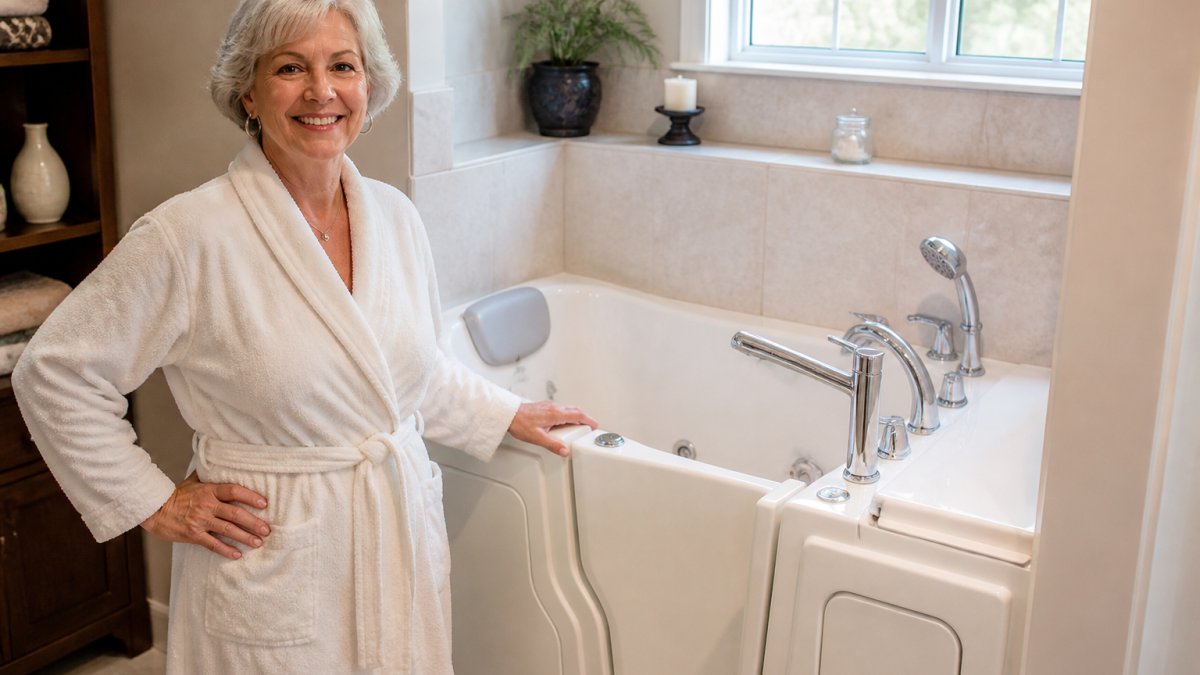
Walk-in tubs are bathing fixtures with a sealed door and a low entry threshold, so a person can step or transfer in, sit on a built-in seat, and bathe without climbing over a tub wall.
Below, I’ll walk you through five real benefits, then the tradeoffs nobody puts in the sales pitch.
Benefit 1: Safer Bathing With a Low Threshold and Built-In Seat
The main safety gain is simple: less climbing. A low threshold and a built-in seat reduce awkward movements between standing and sitting.
That’s the honest version. A walk-in tub does not make a bathroom risk-free. You still step over a threshold, you still get wet, and you still have to stand up from a seated position. Anyone who says otherwise is selling, not teaching.
Where the Real Fall Risk Lives
If you want the deeper evidence-based answer on whether these tubs actually prevent falls, we wrote a separate piece on walk-in tub safety facts. Read it before you let anyone promise you a fall-proof bathroom.
Benefit 2: Independent Bathing and Aging in Place
Independence is the benefit families feel fastest. When bathing stops requiring a helper, dignity comes back into the room.

Aging in place means staying in your own home as your needs change. Bathing is one of the first daily tasks that forces a choice: accept help, or modify the bathroom.
I won’t oversell this. Some mobility levels call for an occupational therapy assessment before any fixture decision. If transfers are already unsafe, a roll-in shower might serve you better.
Benefit 3: Warm Water and Therapeutic Jets for Aching Joints
Let me separate three things mashed together in every walk-in tub brochure: what warm water physically does, what people report feeling, and what research has actually proven. Keep those apart and you’ll decide better than most buyers.
What Warm Water Actually Does
Heat is a vasodilator. Warm water widens blood vessels near the skin, relaxes muscle tissue, and reduces the sensation of stiffness. That’s physiology, not marketing. Buoyancy matters too: seated in a deep fill, water supports part of your body weight, making a stiff hip or shoulder easier to move gently than on dry land.
What warm water does not do is repair cartilage, reverse arthritis, or treat a disease. Anyone who tells you a tub is a treatment is either confused or selling.
What People Report
During 2010-2016 we ran a nurse-supervised, twelve-week customer observation effort built on self-reported experiences with discomfort, mobility, flexibility, and stress. The records need reconciliation before I’d publish any number, so I won’t quote a sample size or percentage.
What the Research Actually Supports
The Arthritis Foundation publishes exercise and therapy guidance worth reading before you spend anything, and the National Institute on Aging has plain-language material on osteoarthritis and joint pain to help frame questions for your clinician. Neither endorses walk-in tubs, and I’m not implying they do.
If you have arthritis, fibromyalgia, diabetes with neuropathy, a heart condition, or open skin wounds, talk to your clinician before you buy.
The Bentley Approach: Medical Hydrotherapy
At Bentley Baths we describe our approach as Medical Hydrotherapy: temperature-appropriate, sanitary, non-aggressive, whole-body thermal and mechanical water effects.
Practically, that means three things to check on any tub you consider:
- Temperature control. Can you set and verify the water temperature, or are you guessing from the tap?
- Sanitation. How does the system drain, dry, and get cleaned between uses? Ask for the manufacturer’s written cleaning protocol.
- Jet character. Are the jets broad and adjustable, or fixed and forceful? Sit in a filled demo if you can. Your back will tell you more than a spec sheet.
For an honest look at whether jets and warm water really help joint pain, read do walk-in tubs help arthritis pain.
The Ritual Matters More Than the Jets
Here’s the part nobody sells. The benefit many people actually get isn’t the jets. It’s the ritual: a warm, private, unhurried twenty minutes at day’s end, seated, door closed, phone in the other room. Buying for the ritual? Buy for comfort, safety, and a seat height you can actually get out of. Buying for a specific medical hope? Talk to your clinician first.
Walk-In Tub Safety Features That Actually Matter
Skip the impressive-sounding feature list and check the ones that change outcomes:
- Grab bars and handholds placed where your hands actually land, not where they look tidy
- Non-slip floor inside the tub and on the bathroom floor around it
- Built-in seat at a height you can push up from
- Locking door with a seal you can verify is watertight
- Emergency drain and release so water exits fast if you need help
- Hand-held shower for seated rinsing
- Good lighting and a clear path to the tub
One more: a phone or medical alert device within reach. That’s not a tub feature, but it’s the single cheapest safety upgrade in the room.
Walk-In Tub Pros and Cons: The Honest Tradeoffs
Walk-in tubs have real drawbacks, and you should hear them from someone who isn’t afraid you’ll walk away.
The pros:
- Seated bathing with less climbing
- Full-body soaking, which a shower can’t provide
- Therapeutic warm water and jets
- Bathing without a helper for many people
The cons:
- You wait in the tub while it fills, and again while it drains
- You need adequate hot water supply for a deep fill
- Doors and seals need care and occasional service
- Installation can involve plumbing and electrical work
- Cost is real, and it’s not a small purchase
That fill-and-drain wait is the complaint I hear most. Plan for it. Bring a towel, or make it part of the ritual.
For the full candid list, see walk-in tub pros and cons.
Walk-In Tub Installation Considerations Before You Sign
Installation is where budgets go sideways, and it’s the part almost nobody explains before the contract is signed. Here’s what actually drives scope, so you can ask better questions than the person across the table expects.
What Actually Drives the Scope
A walk-in tub is not a drop-in swap for a standard tub. Four things determine the work:
- The drain location. Walk-in tubs often need the drain repositioned, because the door and the pump housing change where water can exit. Moving a drain is real work, not a trim piece.
- The door swing and clearance. An inward-swinging door needs room inside the tub footprint. An outward-swinging door needs floor space in the bathroom. Measure the actual path from the doorway to the tub before you fall in love with a model.
- The electrical supply. Jets, lights, and heaters need a dedicated circuit and a GFCI-protected outlet, installed by a licensed electrician. If your bathroom panel is already full, that is a real added cost and a real added delay.
- The hot-water supply. A deep fill needs a lot of hot water at once. If your water heater is undersized or near the end of its life, you will either wait, run lukewarm, or replace the heater. Ask the installer to calculate the fill volume against your heater’s capacity before you sign.
The Hot-Water Question Nobody Asks
This is the one I wish every buyer asked first. A deep walk-in tub holds far more water than a standard tub, and the fill has to stay hot for the whole soak. If your heater can’t keep up, the tub will disappoint you no matter how good the jets are. Ask for the tub’s fill capacity in gallons and your heater’s first-hour rating, and make the installer show you the math. If they can’t, that tells you something.
Who Is Accountable
Permits, inspection, and warranty service are where finger-pointing starts. Get these in writing before you sign:
- Who pulls the permit, and whose name is on it?
- Who is responsible if the inspection fails?
- Is the warranty from the manufacturer, the installer, or both, and who do you call first when a door seal leaks?
- What is the stated service response time, and is it in the contract or just promised verbally?
- What does the written estimate include, and what is explicitly excluded?
A verbal promise about ‘handling it’ is worth exactly nothing when the crew is gone.
Before you compare quotes, ask each installer for a written scope that lists plumbing, electrical, permits, disposal of the old tub, and finish work as separate line items.
What to Ask About the Contract Itself
Read the cancellation language before you sign, not after. The FTC’s three-business-day Cooling-Off Rule applies only to qualifying transactions, typically sales made at your home or away from the seller’s normal place of business, and it has exceptions. Verify current FTC guidance and your state’s law. Already facing a deadline? Go straight to official FTC and state consumer-protection resources rather than waiting to book an appointment with anyone, including me.
We break down what installation actually involves in our walk-in tub installation cost breakdown. Read it before you compare quotes, and bring your written estimate to a Free Walk-In Tub Estimate / Second Opinion if anything in it feels vague.
Walk-In Tub Alternatives Worth Comparing First
A walk-in tub is not the only answer. Compare these before you commit:
| Option | Best For | Main Tradeoff |
|---|---|---|
| Walk-in tub | Seated soaking plus showering | Fill and drain wait time |
| Accessible shower | Wheelchair or walker access | No deep soaking |
| Roll-in shower | Zero-threshold transfers | Requires more floor space |
| Tub cut conversion | Lower cost, keeps existing tub | Limited depth and seating |
| Grab bars and seating only | Early, mild mobility changes | Doesn’t solve tub wall climbing |
My view, and it’s a strong one: a properly equipped walk-in tub gives you seated showering and full-body soaking, and a shower can’t give you the soak.
For a direct comparison, read shower vs bathtub for senior mobility.
If you’re still early in the process, our free Safe Bathing Course walks you through room-by-room checks you can do this weekend.
The bathroom doesn’t have to be the room you dread. It can be the one place where you start and end the day comfortably, on your own terms.
At Bentley Baths, we’ve spent over 15 years studying accident prevention and walk-in bathtub benefits.
Get started with Bentley Baths and schedule your free evaluation. Call 800-688-0055 or visit BentleyBaths.com.
Frequently Asked Questions
What are the main benefits of walk-in tubs for seniors?
The five that matter most are a low entry threshold, a built-in seat, warm-water soaking, seated showering when the tub is equipped for it, and support for aging in place. They are not risk-free, and a tub alone does not guarantee fall prevention, so look at the whole bathroom.
Can you shower while seated in a walk-in tub?
A properly equipped walk-in tub can support seated showering and full-body soaking. Ask whether the model you are considering supports seated showering and whether it suits your needs.
How much do walk-in tubs cost, and what should I check first?
Pricing depends on the product and project scope, so ask Bentley Baths for current pricing or a quote. Before you sign, review the installation scope, warranty terms, and service arrangements. If you already have an estimate, request a second opinion. If you have signed, check official FTC guidance and your state’s law promptly.
Are walk-in tubs suitable for everyone?
No. A walk-in tub is not right for every situation. Certain mobility needs call for an occupational therapy or other qualified assessment. Bentley Baths offers free in-home evaluations.