Skip to content

Last Updated: November 5, 2026
Quick Summary
Home modifications for senior safety are physical changes that reduce injury risk and support daily independence, from grab bars in the shower to a stairlift. Fix the bathroom first, since wet surfaces, tight spaces and weight shifts make it the highest-risk room. Plan changes before a crisis forces the decision.
- Anchor grab bars into studs or blocking, never drywall anchors or towel bars.
- A walk-in tub reduces risk but still requires sitting, standing and stepping over a threshold.
- Aim for at least 36 inches of clear width where a walker or wheelchair must pass.
- Rank findings by likelihood and consequence, then fix cheap, fast hazards this week.
- Re-check grab bars, night lights and rug tape every six months.
Table of Contents
- Why Home Modifications for Senior Safety Matter
- Bathroom Safety for Seniors: The Room That Matters Most
- Stairs, Ramps, and Step-Free Access
- Flooring, Lighting, and Trip-Hazard Fixes
- ADA-Compliant Bathroom Modifications vs. Standard Updates
- How to Run an Aging in Place Home Assessment
- Your Senior Home Safety Checklist
- Should You Modify or Move? A Decision Framework
- Frequently Asked Questions
Why Home Modifications for Senior Safety Matter
Most people call me after the fall, not before it.
Home modifications for senior safety are physical changes to a house that reduce injury risk and support daily independence as mobility, vision and balance change.
Here is the part most guides skip: the goal is not to make a home look medical.
CDC data on older adult falls makes the stakes plain. Falls are not a minor inconvenience of aging.
That is why I tell folks to call before you fall.
Bathroom Safety for Seniors: The Room That Matters Most
If you only fix one room, fix this one. Bathroom safety for seniors matters more than any other room because it combines the three things that cause falls: hard wet surfaces, tight spaces, and a moment where you must shift your weight while your hands are busy.
The good news is that the fixes are well understood.
Grab Bars, Seating, and Non-Slip Surfaces
Properly anchored grab bars, screwed into blocking or studs, placed where you actually reach, are among the most useful changes you can make in a bathroom.
Add a shower chair or built-in bench so you can sit rather than stand. Swap the smooth tub floor for a textured mat or applied non-slip strips.
For the actual placement rules and measurements, our guide to ADA compliance grab bars walks through the standards.
Walk-In Tubs, Curbless Showers, and the Tradeoffs
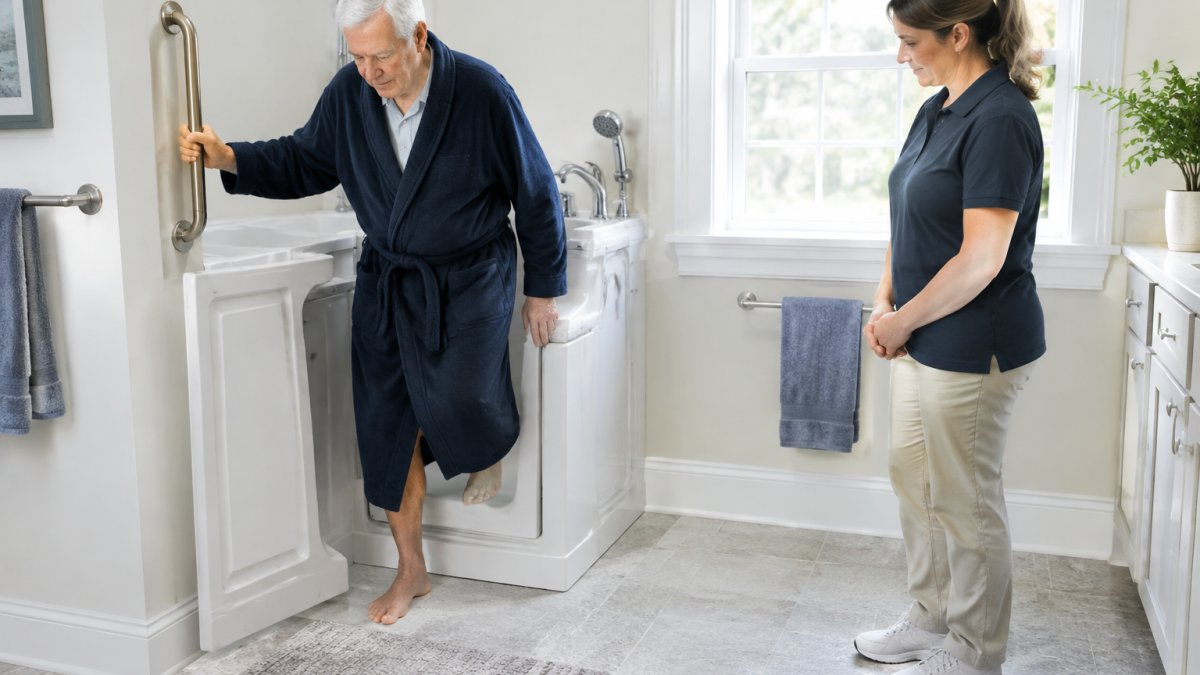
A walk-in tub gives you a low entry door, a built-in seat, and the ability to soak your whole body.
Neither is universally better. If your priority is deep immersion and warmth for aching joints, a tub makes sense. We compare them honestly in roll-in shower vs walk-in tub.
Watch out: a walk-in tub still requires you to sit, stand, and step over a threshold. It reduces risk. It does not eliminate it.
Stairs, Ramps, and Step-Free Access
Stairs are where the second-biggest risk lives, and where the fix is often more structural than people expect.
A stairlift carries you up and down an existing staircase. A platform lift handles a short set of steps at an entry.
The mistake I see most: families buy the lift before checking the landing space. Measure first, buy second.
If stairs are the barrier keeping someone from aging in place, our stair lifts, ramps, and home elevators page shows the actual equipment options.
Flooring, Lighting, and Trip-Hazard Fixes
This section is the cheapest and the most neglected.
Start with the floor. Replace thick carpet and deep-pile rugs with low-pile or slip-resistant surfaces.
Then fix the light. Add brighter bulbs, motion-sensor night lights in hallways and bathrooms, and switches at both ends of a room.
Rearrange furniture to widen walkways. Reduce fall risk one trip hazard at a time.
ADA-Compliant Bathroom Modifications vs. Standard Updates
ADA-compliant bathroom modifications follow published accessibility standards, including clear floor space, grab bar placement, door widths, and turning radius.
If you are modifying a bathroom for someone with real mobility limits, consider building to the accessibility standard even when the code does not require it.
For a broader look at the basics, our overview of bathroom safety for seniors covers the critical aspects room by room.
How to Run an Aging in Place Home Assessment
An aging in place home assessment is a room-by-room walkthrough that identifies where a person actually struggles, then ranks fixes by risk and cost. Do it before you buy anything. The mistake most families make is treating the assessment as a feeling rather than a measurement.
Here is how I run one. It takes about ninety minutes in a typical single-story house, longer if there are stairs.
Start With the Person, Not the House
Walk the house with the person who lives there and ask three questions in every room:
- Where do you hold on to something for balance?
- What do you avoid doing because it feels unsteady?
- Where is the light worst?
Their answers will surprise you. The bedroom closet, the back steps, the tub. Not always the room you expected. I have had clients confess they stopped using the good shower years ago and never told their daughter.
Watch out: if the person is minimizing problems to avoid being told to move, you will get polite answers instead of honest ones. Ask the caregiver separately, and ask what tasks have quietly stopped happening.
The Room-by-Room Hazard Inventory
Go through each zone and score every finding on two axes: likelihood of a fall or injury, and consequence if one happens. A loose rug at the top of stairs is low likelihood, catastrophic consequence. A dim hallway is high likelihood, moderate consequence.
Hallways and stairs. Look for handrails on both sides, contrast strips on the first and last step, a light switch at both ends, and clear width.
Bathroom. This is the highest-risk room.
Kitchen. Frequently used items at waist height, lever handles on the faucet, good task lighting over the counter, and no step stool in daily use.
Laundry and utility. Front-loading machines, a stool for sitting, and clear floor space. Falls in the laundry room are common and rarely discussed.
Rank, Then Sequence
Once you have the inventory, sort every finding into three buckets:
- Fix this week. High likelihood and high consequence, or anything cheap and fast. Grab bars, rug removal, night lights, clearing walkways.
- Fix this quarter. Needs a contractor or a purchase decision. Shower seating, lighting upgrades, lever handles, raised toilet.
- Plan for. Structural or expensive. Stairlift, ramp, walk-in tub, doorway widening.
The sequencing matters more than the list. A family that spends its whole budget on a stairlift and leaves the bathroom untouched has solved the wrong problem first.
Measure Whether It Actually Worked
This is the step almost nobody does. After the work is done, go back and check three things:
- Can the person now do the task they were avoiding, without holding on to something that is not a grab bar?
- Is the grab bar still tight against the wall after a month of use? Grab bars loosen. Check the mounting screws.
- Are the night lights still working, and are the batteries fresh?
A modification that is not maintained is not a modification. It is a decoration. Put a reminder on the calendar to re-check grab bars, lighting, and rug tape every six months.
If you want a professional set of eyes, we offer a free assessment with an age-in-place specialist, in home or virtual. Bring the checklist below and ask them to score each finding the same way.
Your Senior Home Safety Checklist
Use this as a working document. Print it, walk the house, and check what is done.
- Grab bars anchored in the tub, shower, and beside the toilet
- Shower chair or built-in bench in place
- Non-slip mat or textured strips in the tub and shower
| Priority | Modification | Typical Effort | Why It Ranks Here |
|---|---|---|---|
| High | Grab bars and handrails | Low | Directly prevents the most common fall |
| High | Remove or secure rugs | Low | Free to cheap, immediate risk reduction |
| High | Bathroom seating and non-slip surface | Low to medium | Wet surfaces are the highest-risk zone |
| Medium | Lighting upgrades and night lights | Low | Improves navigation after dark |
| Medium | Lever handles and raised toilet | Low | Reduces strain and dexterity risk |
| Higher cost | Stairlift, ramp, walk-in tub | High | Solves access, needs professional install |
Should You Modify or Move? A Decision Framework
This is the question that keeps people up at night, and it deserves a straight answer rather than a sales pitch. I have sat at a lot of kitchen tables while a family argued about this, and the argument is rarely about the house. It is about control, money, and fear of being a burden. So let us separate those.
The Five Questions That Actually Decide It
- Can the house be made safe? If the bathroom and the entry can be modified, most single-story homes can work. If the only bathroom is upstairs and there is no room to add one down, that is a real constraint.
- Is the bedroom on the main floor? If not, can it be moved there without a major addition? A main-floor bedroom and bath solve more aging-in-place problems than any product I sell.
- What does the money actually look like? Compare the cost of the modifications against the cost of moving: closing costs on the sale, movers, the new place, and the ongoing cost difference. Get written estimates for both. Do not compare a real modification quote to a vague guess about moving.
- Is the person willing? A safe house someone resents is not a safe house. They will fight it, and they will win. Ask what they want before you tell them what they need.
- What do the next five years look like? Plan for changing needs, not just today’s. A modification that only works for this year’s mobility is a stopgap, not a solution.
If the answer to the first two is yes and the money works, modify. If the layout cannot work and the budget cannot bridge it, moving may be the kinder choice. There is no shame in either.
How Specific Conditions Change the Answer
This is where most guides go quiet, and it matters. The right call depends on what is actually changing.
Low vision. Contrast and lighting become the priority.
Balance problems. Grab bars, non-slip surfaces, and removing stairs from daily life become the deciding factors.
Wheelchair or walker use. Doorway widths, turning radius, and a roll-in shower become non-negotiable.
Cognitive change. This is the hardest one.
The Emotional Math Nobody Writes Down
Leaving a house means leaving neighbors, a church, a garden, a route to the grocery store. That has real value, and it does not show up on a spreadsheet. But staying in a house that isolates someone because they are afraid of the stairs has a cost too. Ask which choice keeps the person more connected, not just more safe.
A Practical Next Step
Before you decide anything, get two written estimates: one for the modifications, one for a realistic move. Then sit down with the person and compare them side by side. And if a walk-in tub is on your list, start with a Free Walk-In Tub Buying Review With George before you sign anything, or brush up on the basics with our Free Safe Bathing Course.
Frequently Asked Questions
Does Medicare cover home modifications for seniors?
Original Medicare generally does not pay for home modifications like grab bars, ramps, or walk-in tubs because they are considered home improvements rather than medical care. Some Medicare Advantage plans may offer limited benefits for certain safety devices, and Medicaid waivers in some states can help with home modifications for eligible people. Check with your plan and your state Medicaid office before assuming coverage. A free in-home evaluation can help you identify what you need so you can ask the right coverage questions.
What are the most effective home modifications to prevent falls?
The highest-value changes target the rooms where falls happen most: the bathroom and the stairs. Grab bars, a shower chair, a handheld shower head, non-slip flooring, and good lighting in the bathroom reduce risk in the room where wet surfaces and hard tub edges combine. On stairs, secure handrails on both sides and proper lighting matter. Removing loose rugs and clearing trip hazards throughout the house rounds out the basics. An aging in place home assessment can tell you which fixes matter most for your specific layout and mobility.
What is the difference between ADA-compliant and standard bathroom modifications?
ADA-compliant bathroom modifications follow the federal Americans with Disabilities Act design standards, which specify things like grab bar placement, clear floor space, and door width for public and commercial facilities. Standard bathroom updates for a private home are not legally required to meet ADA standards, but many homeowners choose to follow them anyway because they reflect tested safety dimensions. For a home, the goal is a bathroom that fits the person using it, so an age-in-place specialist may recommend a mix of ADA-compliant features and custom solutions.
How do I assess my home for senior safety liabilities?
Walk through each room with a notepad and look for the same things a specialist would: loose rugs, poor lighting, missing grab bars, high tub edges, slippery floors, and clutter in walkways. Test how easily doors open, whether light switches are reachable, and whether stairs have secure railings on both sides. A professional aging in place home assessment adds measurements, an understanding of how your mobility may change, and prioritization so you spend money where it reduces risk most. Many providers offer this evaluation at no cost.
How can I prioritize home safety projects on a budget?
Start with the changes that cost little and reduce risk immediately: remove loose rugs, add night lights, secure handrails, and clear walkways. Next, address the bathroom, since it is where falls are most common and most serious. Lower-cost fixes like grab bars and a shower chair come before larger projects like a walk-in tub or curbless shower. Ask for a written estimate that separates materials, labor, and permits so you can compare options fairly. A free buying review can help you decide what to do now and what can wait.