Skip to content

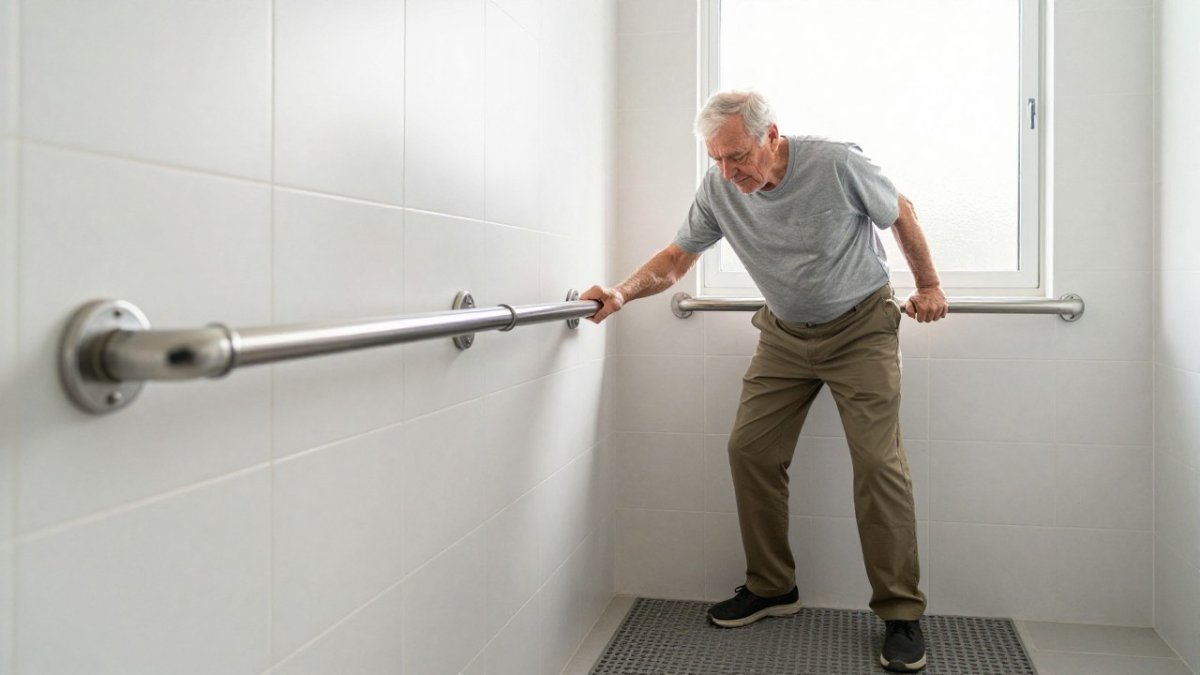
Quick Summary
Heavy duty grab bars for heavy people should be rated for a higher load than standard bars, and the rating must be confirmed for the exact model. Steel and stainless steel bariatric bars are the strongest options, but the bar is only as safe as the wall behind it. Anchor it into solid backing, not drywall alone.
- Standard grab bars are often rated for a modest load, so check the stated capacity before buying.
- Ask the seller for the rated capacity of the exact model, in writing, along with its test conditions.
- Your body weight is not the load; lowering or rising can briefly exceed it, so choose a higher rating.
- Suction-cup bars are only for light support and should never be your primary load-bearing point.
- Anchor the bar into wood studs or solid blocking, and confirm the fastener plan against your wall type.
Table of Contents
- Why Heavy Duty Grab Bars Matter for Heavier Users
- How Much Weight Can a Grab Bar Hold?
- Heavy Duty Options Compared: Steel, Stainless and Bariatric Bars
- Heavy Duty Suction Grab Bars for Shower Use: Where They Fall Short
- Grab Bar Installation in a Shower: What Actually Holds the Load
- Choosing a Bar for Your Bathroom Layout and Grip Comfort
- Before You Buy: Getting a Heavy Duty Bar Installed Right
- Frequently Asked Questions
Heavy Duty Grab Bars for Heavy People: What to Buy
Last Updated: November 14, 2026
Why Heavy Duty Grab Bars Matter for Heavier Users
Bentley Baths has spent years helping people make safer bathroom choices, and I’ll be direct: a standard grab bar is not built for everyone.
Here’s the part most shoppers miss. A grab bar is only as strong as the wall behind it.
Heavier users also need a comfortable grip and a mounting position that fits how they really move. A strong bar can still be hard to grip if it does not suit the user’s hand.
This guide covers capacity ratings, materials, suction-cup limits, installation, and layout, so you can buy with your eyes open.
How Much Weight Can a Grab Bar Hold?
A grab bar’s rated capacity is a number the manufacturer attaches to the bar itself, tested under specific conditions.
A rating is only meaningful when you know what the bar is made of, how it was tested, and what it was fastened into.
Capacity figures vary widely across steel and bariatric bars, and a number on a label is only a reference point. Ask the seller for the rated capacity of the exact model in writing, and what test conditions that number assumes.
User Weight Versus Grab Bar Load Rating
Here is the distinction that trips up many buyers. Your body weight is not the same as the load the bar must carry.
So a 250-pound person is not automatically fine with a 250-pound bar. A heavier user should look for a higher stated capacity and confirm it applies to the specific product in hand. Do not assume a label like “bariatric” guarantees a number for every model. Labels are marketing. Ratings are engineering. Ask for the engineering.
What a Rating Actually Tests
A load rating generally reflects how the bar performs in a controlled test, often mounted to a test fixture with force applied in a set direction.
What it does not tell you is whether your wall, your fasteners, and your installer can deliver that same performance in your home. The test fixture is not your shower wall.
Watch out: a rating printed on a package is not the same as an independent certification, and some listings use vague language like “heavy duty” or “commercial grade” without stating a tested load at all.
The Questions to Ask Before You Trust a Number
When you are comparing heavy duty grab bars for heavy people, put these questions to the seller or the installer:
- What is the rated capacity for this exact model, in writing?
- What mounting conditions does that rating assume?
- Is the rating based on the manufacturer’s own testing, or on an independent standard?
- What fasteners and backing does the installation require to achieve that rating?
- What does the warranty say about a mount failure, as opposed to a finish defect?
If a seller cannot answer those, you have learned something useful. A confident answer is worth more than a bold number on a box. If you want a second set of eyes on the plan, that is exactly the kind of conversation I am happy to have before you spend real money.
Heavy Duty Options Compared: Steel, Stainless and Bariatric Bars
Heavy-duty bars come in a few families. Here’s how they compare based on what the research supports.
| Option | Reported Capacity | Price Reference | Best For | Watch For |
|---|---|---|---|---|
| Steel bathtub and shower bar | Up to 500 lbs with proper backing | Not shown in source | Higher capacity with secure backing | Price, dimensions, and installation details not confirmed |
| Bariatric grab bar category | Up to 1,250 lbs (category maximum) | $60 to $700 | Shoppers prioritizing top capacity | Capacity varies by model |
| Heavy-duty stainless steel bars | Not stated per configuration | From $86.97 (1¼-inch bars) | Fixed, angled, corner, or flip-up layouts | ADA wording does not confirm your installation meets requirements |
| Standard grab bar (review pick) | Up to 250 lbs | Under $50 | Lighter users and budget shoppers | Lower capacity than heavy-duty options |
Steel is strong and widely available. Stainless steel resists corrosion, which matters in a damp bathroom where cheaper finishes can pit and weaken.
Configuration matters too. Angled and corner bars can help with transfers, while flip-up bars clear space when not in use. The right shape depends on where you need support.
Heavy Duty Suction Grab Bars for Shower Use: Where They Fall Short
Suction-cup grab bars are tempting because they need no drilling. For a heavier user, though, they carry real risk. A suction cup depends on a smooth, clean, non-porous surface and a good seal. Soap film, moisture, temperature swings, and age all weaken that seal, and the bar can release without much warning.
Use suction bars only for light support, like steadying yourself while you stand, and never as your primary load-bearing point for lowering or rising. If you’re a heavier user or your mobility depends on the bar, a wall-mounted bar fastened into solid backing is the safer choice.
Grab Bar Installation in a Shower: What Actually Holds the Load
This is where a well-chosen bar can fail. The bar may be strong, but the wall behind it may not be. A rushed installation can leave a bar loose within months, and that is a real safety concern.
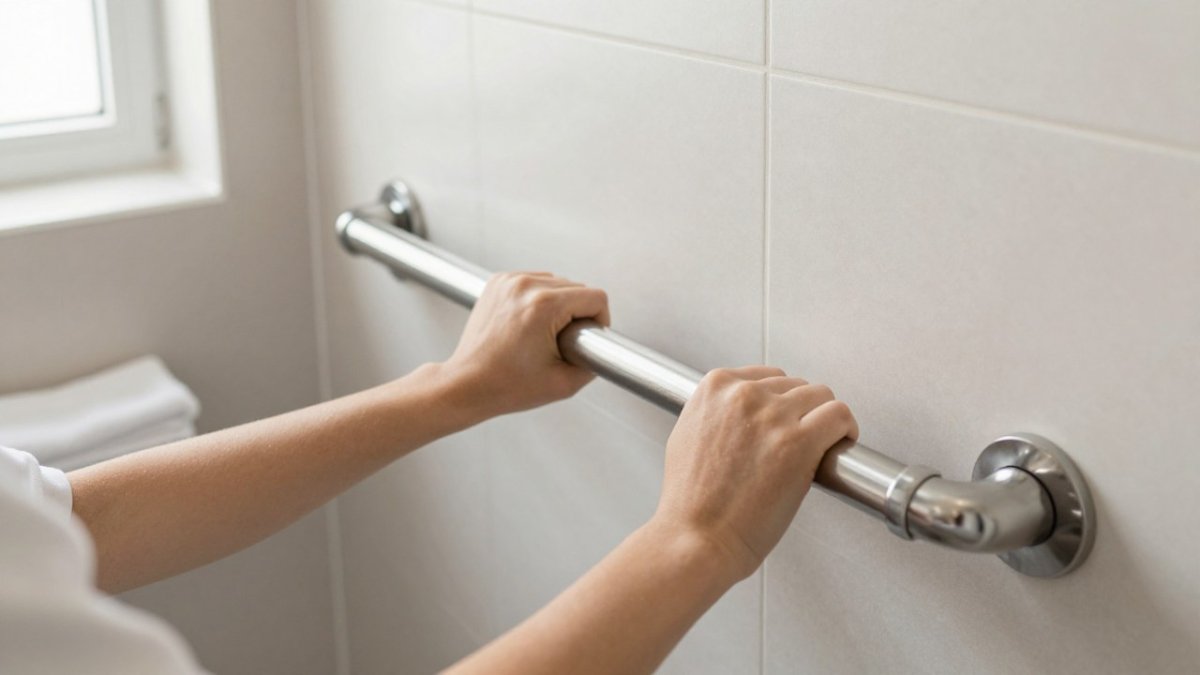
A shower grab bar needs to be anchored into something structural: a wood stud, a solid blocking board installed for the purpose, or a reinforced masonry wall. Screws driven into drywall or tile alone will not hold a heavy load, no matter how impressive the bar’s rating. Tile is a surface, not a structure. Drywall is a wrapper, not a frame.
What Is Actually Behind Your Wall
Before you buy anything, find out what is back there. In a typical wood-frame bathroom, studs are usually spaced on a regular layout, and a stud finder plus a cautious probe can map them.
If you are remodeling, install blocking during the work so the bar has solid wood to bite into wherever you might want support now or later.
If you are retrofitting, a qualified installer can locate studs and confirm anchor points. Ask them to show you the backing before they drill, not after. A good installer will not be offended by that request.
Fasteners and Anchors Are Not Interchangeable
The fastener matters as much as the bar. Lag screws into solid wood blocking behave very differently from toggle bolts into a hollow wall, and both behave differently from masonry anchors into block.
An installer may use whichever anchor is on hand rather than the one the situation calls for. That is how a heavy duty bar ends up held by hardware meant for a picture frame.
Watch out: some bars are sold with mounting hardware included, and that hardware may assume a wall type that is not yours. Confirm the fastener plan against your actual wall before drilling.
Placement Is Part of the Load Problem
Where the bar goes affects how much force it takes. A bar mounted where your hand naturally lands during a transfer gets gripped squarely and loaded in line with its strongest direction.
Before installation, sit where you will sit, stand where you will stand, and note where your hand reaches. Mark that spot. Then confirm there is structure behind it. If there is not, the conversation shifts to adding blocking or choosing a different location, and that is a conversation worth having before the drill comes out.
What Installation Actually Costs
Expect the installed cost to be more than the bar’s price. Hardware, labor, and any wall repair all add up, and a retrofit that requires opening a wall to add blocking costs more than a simple mount into existing studs.
If you are unsure whether your bathroom can take a heavy-duty bar, or you want a second opinion before you commit, that is a conversation I welcome. Bentley Baths offers a free Walk-In Tub Buying Review with George, which can be a place to talk through your options before you spend. You can reach us at BentleyBaths.com or 800-688-0055.
Choosing a Bar for Your Bathroom Layout and Grip Comfort
Layout decides where a bar should go, and grip decides whether you’ll actually use it. A bar that’s too thin, too smooth, or mounted at the wrong angle can be hard to hold, especially for larger hands or users with arthritis.
Measure before you buy. Note where you put your hand when you sit down, stand up, and step over the tub edge. Mount the bar where your hand naturally goes, not where it looks neat.
Look for a diameter that fits your hand, a textured or non-slip surface, and clearance between the bar and the wall so your knuckles don’t scrape.
Before You Buy: Getting a Heavy Duty Bar Installed Right
Buying the right bar is only half the job. Here’s a practical checklist before you commit money.
- Confirm the rated capacity for the exact model and the conditions it assumes.
- Ask the installer where they’ll anchor the bar and how they’ll verify the backing.
- Get a written estimate covering the bar, hardware, labor, and any wall repair.
- Check the warranty and what it covers if a mount fails.
- Ask how the bar will be positioned relative to your transfer points.
If you’re unsure whether your bathroom can take a heavy-duty bar, a home safety evaluation can help. Bentley Baths offers a free Walk-In Tub Buying Review with George, which is a good place to talk through your options before you spend.
Heavier users deserve bathroom hardware that holds, fits their hands, and goes where they actually need it. Check the wall, confirm the rating, and get a clear written estimate.
Frequently Asked Questions
How much weight can a grab bar hold?
Most standard residential grab bars are rated around 250 pounds, while heavy duty and bariatric bars are often marketed with much higher figures, such as 500 or 1,250 pounds. These ratings describe the load the bar itself can take under ideal conditions, not what it can safely support once mounted. The wall, anchors and screws determine how much weight the installed bar really holds. Check the manufacturer’s stated rating, confirm it was tested with mounting into solid backing, and have the installer verify that the wall can carry the load before you rely on it.
Are heavy duty suction grab bars safe to use in a shower?
Suction grab bars can be useful for light, temporary support, but they are not a reliable choice for a heavier person who needs to pull or push against the bar when getting up or down. Suction seals can weaken with soap residue, water and temperature changes, and they can release without warning. For anyone who depends on the bar for balance, a screw-mounted bar fixed into wall framing or solid backing is the safer option. Ask a qualified professional to assess your specific needs.
How do I know whether a grab bar is securely installed?
Grab our attention to the mounting first. A secure bar is fastened into studs or solid blocking with appropriate hardware, not just drywall anchors. Once installed, grip the bar and push and pull firmly in several directions. Any movement, flex or creaking means the installation needs to be reviewed. Keep the installation receipt or documentation, and ask the installer to explain what backing they used.
What size grab bar is best for a shower?
Most people find a bar with a diameter between about 1 1/4 and 1 1/2 inches comfortable to grip, and heavier users often benefit from a bar that is easy to wrap a full hand around. Length should match where you actually reach, and the bar should be placed so you can grip it before you need to shift your full weight onto it. Measure your reach while seated and standing before choosing a length.