 Skip to content


Last Updated: November 13, 2026
Quick Summary
A slide in bathtub for wheelchair use is a seated fixture with a watertight door and low entry, but the bather must still transfer from the chair onto the tub seat. Plan the transfer, measure the room, and confirm clear floor space before choosing any tub.
- A wheelchair bathtub transfer works in four moves: position the chair, lock it, clear the armrest and footplates, then move onto the seat.
- Seat height should roughly match the wheelchair seat so the transfer stays level, not uphill.
- Measure doorway width, turning space, and clear floor space beside the tub before you shop for a fixture.
- A door that swings into the transfer zone can block the exact space the wheelchair needs.
- ADA standards are a useful reference for accessible design in a private home, but confirm requirements with local authorities.
Table of Contents
- Slide In Bathtub for Wheelchair: The Decision Nobody Explains
- Quick Comparison: Slide-In Tub, Roll-In Shower, and Transfer Bench
- How a Wheelchair Bathtub Transfer Actually Works
- What Makes a Bathtub Truly Wheelchair Accessible
- Measuring Your Bathroom Before You Fall in Love With a Tub
- Slide In Bathtub for Wheelchair Cost: What Drives the Number
- Safety Features, Caregiver Access, and ADA in a Private Home
- Book a Free Buying Review Before You Sign Anything
- Frequently Asked Questions
Slide In Bathtub for Wheelchair: The Decision Nobody Explains
Most people shopping for a slide in bathtub for wheelchair use start with the tub. That is the wrong end of the horse.
A slide-in tub is a walk-in bathtub built with a wide, low entry and a built-in seat, designed so a bather can sit down at the rim and swing or slide the legs across rather than step over a standard wall.
Here is the part that trips people up. A slide-in tub still requires the bather to get from the wheelchair onto the tub seat. That move, not the tub, is where the real planning happens.
CDC STEADI older adult fall prevention guidance
What a Slide-In Tub Actually Is, and What It Is Not
A slide-in tub is a seated bathing fixture with a watertight door and a transfer-friendly rim. It is not a substitute for a properly assessed transfer plan, and it is not a roll-in shower.
Three things separate it from a standard bathtub:
- A door that opens. You walk or transfer through the door, not over a wall.
- A built-in seat. The seat height and depth drive whether a transfer is realistic for the bather.
- A low entry threshold. Lower than a standard tub rim, but not zero.
What it is not: a guarantee of safety, a replacement for grab bars and assessment, or a one-size answer for every mobility limitation. Some bathers need an occupational therapy assessment before any fixture is chosen.
Quick Comparison: Slide-In Tub, Roll-In Shower, and Transfer Bench
The fastest way to choose is to compare the three realistic paths side by side. A slide-in tub suits a bather who can transfer onto a seat and wants soaking. A roll-in shower suits a bather who stays in a shower chair. A transfer bench is the budget path that works with an existing tub.
| Option | How You Enter | Best For | Main Tradeoff |
|---|---|---|---|
| Slide-in tub | Open door, sit, swing legs | Bathers who can transfer and want soaking | Needs transfer ability and space |
| Roll-in shower | Wheel straight in on a chair | Bathers who stay seated in a shower chair | No deep soaking |
| Transfer bench | Slide across from chair to bench | Budget-minded, existing tub stays | Still requires a tub wall clearance |
For a deeper head-to-head, read our full breakdown of roll-in shower vs walk-in tub before you commit to a path.
How a Wheelchair Bathtub Transfer Actually Works
A wheelchair bathtub transfer works in four moves: position the chair, lock it, clear the armrest and footplates, then move the body onto the seat with the feet planted and one hand on a fixed grab bar. The tub is the easy part. The transfer is where the plan either holds or falls apart.
Picture the sequence, because the order matters more than the speed:
- Park the wheelchair parallel to the seat, close enough that the bather’s hip nearly touches the rim.
- Lock both wheels. Flip the footplates up so the feet can reach the floor.
- Remove or swing away the armrest on the tub side. An armrest left in place turns a slide into a climb.
- Place both feet flat on the floor or a stable, non-slip step. Never on the tub rim, never on the door.
- Slide or pivot onto the seat, using a grab bar for support. The door is a moving part, not a handhold.
A common mistake is buying the tub before measuring the transfer. If the chair cannot get close enough and square to the seat, the tub is decorative.
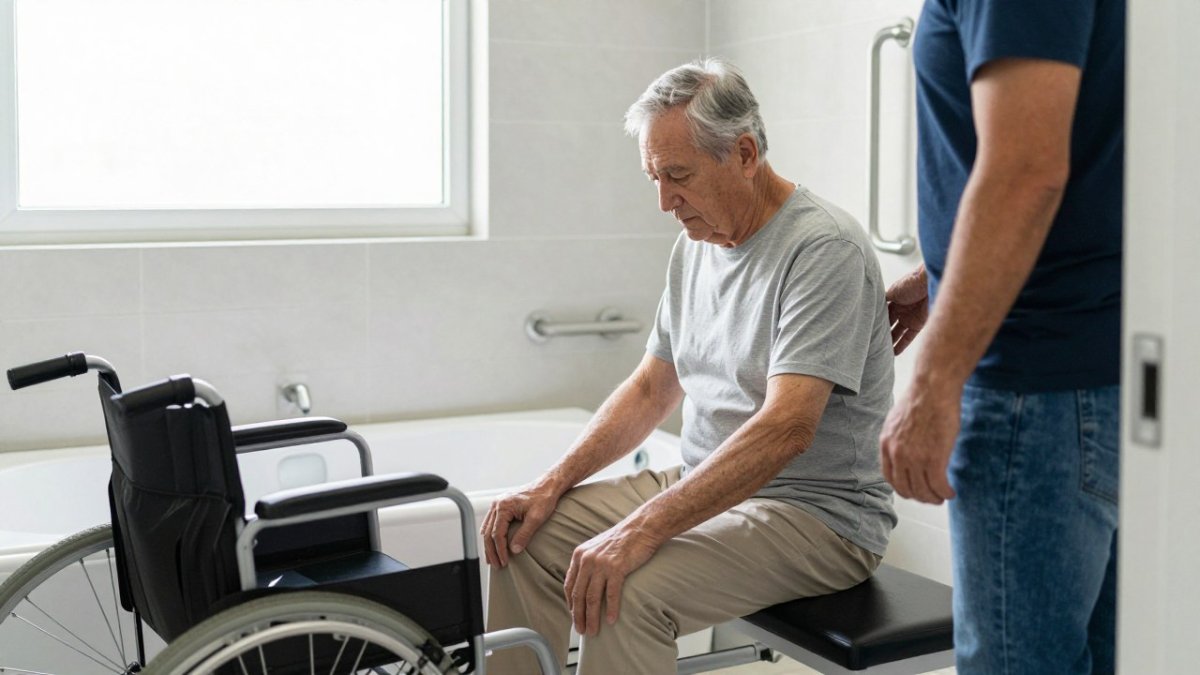
Seat Height, Transfer Clearance, and the Grab Bar Question
Seat height should roughly match the wheelchair seat so the transfer stays level, not uphill.
Transfer clearance is the open floor space beside the tub that lets the chair sit square to the seat.
Direction matters too. A lateral slide, moving sideways from chair to seat, is usually the steadiest when the seat is level with the chair.
The grab bar question has a clear answer: mount bars where the bather’s hand naturally lands during the transfer, and never rely on the door or the tub rim as a handhold.
When a Caregiver Changes the Math
If a caregiver will assist, the room has to fit two people, not one. That means standing room beside the tub, a clear path for the caregiver’s feet, and a seat the caregiver can reach without twisting. A caregiver who has to lean across a wheelchair to steady a bather is not assisting. That caregiver is improvising, and improvisation is where backs get hurt.
What Makes a Bathtub Truly Wheelchair Accessible
A bathtub is truly wheelchair accessible when the door, threshold, seat, and surrounding floor all support a seated transfer without a step over a wall. Accessibility is a system, not a single feature.
That system includes:
- A door wide enough for the bather’s body and any transfer aid
- A threshold low enough to clear without a high lift
- A seat at a workable height with a non-slip surface
When you are ready to see the fixtures themselves, browse our hydrotherapy walk-in and slide-in tubs and ADA-compliant showers.
Door, Threshold, and Seat Design
Door design decides how the bather enters. An inward or outward swing affects the space needed in front of the tub. Threshold height decides how much lift the feet need. Seat design decides comfort during a long soak.
Watch out: a door that swings into the transfer zone can block the exact space the wheelchair needs. Confirm the swing direction against your floor plan before ordering.
Measuring Your Bathroom Before You Fall in Love With a Tub
Measure the room before you measure your budget. The three numbers that kill most slide-in tub projects are doorway width, turning space, and the clear floor area beside the tub.
Grab a tape and record these, at the tightest point, not the friendliest one:
- Doorway width at its narrowest, including the door slab and hinges. A wheelchair has to clear the frame, not the opening on the drawing.
- Turning space in the room. A chair needs room to turn and to back out. A bathroom that only works in one direction traps people.
- Clear floor space beside the tub for the transfer, measured from the tub rim to the nearest wall or fixture.
A common mistake is assuming the old tub footprint is the new one. Slide-in tubs often run larger than a standard tub, and the door and frame add depth in front.
A Simple Fit Checklist You Can Run Yourself
You do not need a drafting table to screen a bathroom. You need honest answers to a few questions.
- Can the wheelchair get through the doorway with the chair’s widest point clearing the frame?
- Can the chair turn or back out without a three-point shuffle that takes two people?
- Is there clear floor space beside the tub where the chair can sit square to the seat?
If any answer is no, that is not a dealbreaker. It is a scope item, and scope items have a way of showing up in the estimate.
For a practical fit guide, use our walkthrough on how to know if a walk-in tub will fit your bathroom.
When the Room Says No
Sometimes the measurements say the bathroom cannot take a slide-in tub without a remodel that costs more than the tub. That is useful information, not a failure. A roll-in shower, a transfer bench with grab bars, or a different layout may fit the room and the bather better. The point of measuring first is to find that out before you fall in love with a fixture that will not fit through the door.
Slide In Bathtub for Wheelchair Cost: What Drives the Number
The slide in bathtub for wheelchair cost is driven less by the tub and more by the room: the door width, the electrical work, the water supply, and the labor to fit it all.
What moves the number:
- Fixture size and features such as door type, seat, and hydrotherapy
- Plumbing changes for supply and drain location
- Electrical work for any pump or heater
Pricing depends on the room, the scope of work, and current confirmation. For an honest look at whether the spend makes sense, read is a walk-in tub worth the cost.
Safety Features, Caregiver Access, and ADA in a Private Home
ADA standards are a useful reference for accessible design in a private home. Confirm any specific requirement with your local authorities. That distinction matters when a salesperson waves the term around.
What ADA gives you is a benchmark for clear floor space, grab bar placement, and reach ranges. What it does not do is guarantee your specific bathroom or bather is safe.
ADA Standards for Accessible Design, U.S. Department of Justice
Book a Free Buying Review Before You Sign Anything
Before you sign anything, get a second set of eyes on the plan.
The right next step depends on where you are. Ready to plan? Schedule a personal consultation with George and bring your measurements.
The hardest part of this decision is not picking a tub. It is admitting the bathroom you have may not be the bathroom you need.
Frequently Asked Questions
Does Medicare pay for handicap bathtubs?
Coverage for bathroom modifications depends on the specific plan and program, and rules differ. Check your plan’s written policy, ask for any coverage decision in writing before you buy, and confirm eligibility directly with the relevant agency rather than relying on a salesperson’s summary.
How much does a slide in bathtub for wheelchair users cost?
The honest answer is that the tub is rarely the biggest line item. Slide in bathtub for wheelchair cost depends on the tub itself, the door and threshold configuration, whether the floor and framing need work, plumbing and electrical changes, and the labor to fit it into your specific bathroom. Published product prices exist for some models, but they exclude installation. Ask every seller for a written, itemized estimate that separates product, labor, permits, and contingency, then compare the totals rather than the sticker.
How do I know whether a slide-in bathtub will fit my bathroom?
Measure before you shop, not after. Record the doorway width, the turning space in front of the tub, the tub alcove length and width, the distance from the floor to the drain, and the seat height you can transfer to safely. A wheelchair accessible bathtub needs clearance for the chair to approach the transfer point, not just to sit in the room. Bring those numbers to a free in-home evaluation so a specialist can flag framing, plumbing, and door-swing problems while you can still change your mind.
Can a wheelchair user transfer into a bathtub without assistance?
Sometimes, but it depends on the person, not the tub. A slide-in tub with a wide door, a low threshold, and a seat at the right height can support an independent wheelchair bathtub transfer for someone with good upper-body strength and balance. Others need a caregiver, a transfer bench, or a lift. Get an occupational therapist’s assessment of your specific transfer before you commit, and never let a sales demonstration substitute for a clinical opinion about your body.
Is a wheelchair-accessible bathtub or an accessible shower a better fit?
A roll-in shower wins on sheer access and is easier for many wheelchair users and caregivers. A slide-in tub wins on soaking, warmth, and the therapeutic value of full immersion, which a shower cannot provide. Some households do better with a tub that supports seated showering and soaking both. The right answer comes from your mobility, your caregiver situation, your hot water supply, and your bathroom layout, so compare all three options side by side before deciding.


