Table of Contents
- Why Book an In-Home Bathroom Safety Assessment
- How to Book an In-Home Assessment: Step by Step
- What Happens During the Visit: A Walk-Through
- The Senior Bathroom Safety Checklist We Use
- Bathroom Fall Risk Assessment: What Gets Measured
- A Home Safety Assessment for Seniors Beyond the Bathroom
- From Findings to Aging in Place Bathroom Modifications
- Choosing a Qualified Assessor and Understanding Costs
- Frequently Asked Questions
Last Updated: October 21, 2026
Why Book an In-Home Bathroom Safety Assessment
Your bathroom may look safe. That is not the same thing as being safe.
I founded Bentley Baths in 2003 after my mother fell in a traditional bathtub. She was not being reckless. She was doing what she had done ten thousand times before. The tub had not changed. She had.
That is why I tell people to book an in-home bathroom safety assessment before they buy anything. A bathroom safety assessment is a room-by-room review of your bathroom, done in your home by someone trained to spot fall hazards, worn surfaces, bad lighting, and missing support. It answers one question honestly: are you actually safe, or have you simply been lucky?
Below, I will walk you through exactly how to book one, what to have ready, what happens during the visit, and how to tell a real assessment from a sales pitch with a clipboard.
Are You Actually Safe, or Have You Just Been Lucky?
Most people who call us have not fallen yet. They are unsteady. They hold the wall. They sit on the edge of the tub and negotiate with their knees.
If standing up has become a hostage negotiation with your joints, that is useful information. It is not a character flaw. It is data.
The CDC’s STEADI initiative for fall prevention makes the point plainly: falls are not a normal part of getting older, and most home falls happen in the bathroom. The CDC also notes that most falls can be prevented with the right changes to the environment.
So no, you are not being sold something you do not need. You are being asked to look at a room you use every day with fresh eyes.
How to Book an In-Home Assessment: Step by Step
Booking an in-home assessment takes about ten minutes on the phone. You do not need to prepare a speech. You need three things: a rough idea of what is getting harder, a list of who else should be in the conversation, and a few questions for the person coming out.
Here is the sequence I would follow.
- Write down what has changed in the last year.
- Decide who else should be present, including a caregiver or adult child.
- Call and ask what the visit includes and who performs it.
- Confirm whether the visit is free and whether there is any obligation.
- Ask what happens after the visit, and get it in writing.
What to Have Ready Before You Call
You do not need measurements or a blueprint. You need honesty about daily life.
- What is getting harder? Standing up, stepping over the tub edge, reaching the faucet, drying off.
- Have you had any near misses? A wobble, a grab at the towel bar, a moment where you caught yourself.
- Who helps you now, and who might need to help later?
- What medications affect your balance or blood pressure? Bring the list.
- What is your budget comfort level, so nobody wastes your time?
A towel bar holds towels. It did not secretly graduate from structural engineering school. If you have been using one for support, say so during the call. That single detail tells an assessor a great deal.
Questions to Ask Before You Book
Ask these on the phone, before anyone sets foot in your home.
- Who performs the assessment, and what training do they have?
- Is the visit free, and is there any obligation to buy?
- Will you give me written findings, or just a verbal pitch?
- Do you install what you recommend, or only sell it?
- What is not included in the scope?
- How long does the visit take?
- Can family join by phone or video if they live out of town?
If the answers get vague, that is your answer. A legitimate assessor will welcome these questions.
The biggest mistake I see is booking an assessment with a company that only sells one product. If the only recommendation is the thing on the truck, you did not get an assessment. You got a demonstration.
What Happens During the Visit: A Walk-Through
A good visit takes 45 to 90 minutes and follows a predictable path. The assessor walks the bathroom with you, tests surfaces and fixtures, watches how you actually move, and writes down findings as they go. You should expect questions, not a monologue.
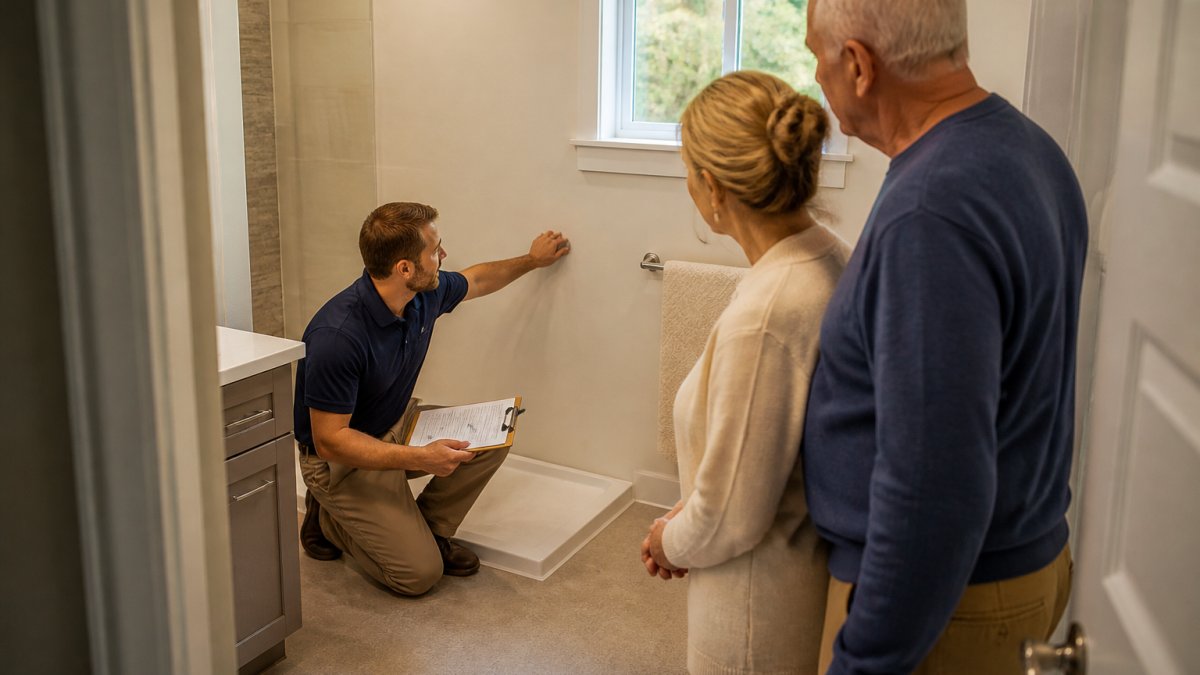
Here is the walk-through we use.
- Entry and doorway. Threshold height, door swing, clearance for a walker or wheelchair.
- Floor. Slip resistance, transitions, loose rugs, water pooling.
- Tub and shower. Step-over height, seating, grab bar placement, handheld shower reach.
- Toilet area. Transfer space, height, nearby support.
- Lighting and ventilation. Brightness, switches, glare, moisture.
- Storage and reach. Where the towels, soap, and medications actually live.
You should leave the visit knowing what is fine, what is marginal, and what needs attention now.
The Senior Bathroom Safety Checklist We Use
A senior bathroom safety checklist is a printable list of hazards and fixes organized room by room. Ours covers eight areas, and you can run it yourself before anyone visits. Print it, walk the room, and mark what you see.
- Grab bars anchored into studs near the tub, shower, and toilet
- Non-slip flooring or a secure mat inside and outside the tub
- A shower seat or bench at a comfortable height
- Handheld shower head within reach while seated
- Bright, even lighting with switches at the door
- Clear pathways with no loose rugs or clutter
- Toilet at a height that allows a safe stand
- Night light between the bed and the bathroom
That list is not a substitute for an assessment, but it is a good start. If you check three or more boxes as missing, it is time to book.
Test your grab bars with a firm pull before you trust them. A bar that moves even slightly is a decoration, not a support. Anchoring into studs or using proper blocking is the difference between help and a hospital visit.
Bathroom Fall Risk Assessment: What Gets Measured
A bathroom fall risk assessment looks at the interaction between the person and the room, not just the room. That distinction matters. Two people can stand in the same bathroom, and one is safe while the other is one wet tile away from a bad night.
Here is what a real assessment measures.
| What Gets Checked | Why It Matters | Typical Fix |
|---|---|---|
| Step-over height | High edges cause trips | Low-threshold entry or seated access |
| Surface slip resistance | Wet tile is the top hazard | Textured flooring or secure mat |
| Support placement | Bars must be where hands go | Anchored bars at tub, shower, toilet |
| Reach and range | Overreach causes loss of balance | Handheld shower, better storage |
| Lighting and glare | Poor light hides hazards | Brighter, even fixtures |
| Transfer space | Tight space limits safe movement | Reconfigure layout or seating |
The National Institute on Aging’s guidance on preventing falls at home is a solid plain-language resource to review before your visit. It helps you ask better questions.
A Home Safety Assessment for Seniors Beyond the Bathroom
A home safety assessment for seniors should not stop at the bathroom door. The path to the bathroom matters as much as the bathroom itself. Most nighttime falls happen in hallways and bedrooms, not in the shower.
Walk the route with the same checklist mindset.
- Night lighting from bed to bathroom
- Loose rugs and cords in hallways
- Stair rails on both sides where possible
- A clear, stable chair for dressing
- Phone or alert device within reach
If stairs are part of daily life, that belongs in the conversation too. We look at stair lifts and platform lifts for the same reason we look at grab bars: the goal is to remove the moment where balance has to save you.
From Findings to Aging in Place Bathroom Modifications
Aging in place bathroom modifications are the changes you make so the room keeps working as your needs change. The findings from the assessment should map directly to a short list of options, ranked by impact and cost.
Small changes come first.
- Grab bars and support rails
- Non-slip surfaces
- Better lighting
- A shower seat and handheld shower
- A toilet-height adjustment
Larger changes come when the small ones are not enough.
- A walk-in shower with a low threshold
- A transition tub
- A walk-in tub with seated soaking and easier entry
I will be honest with you: I favor walk-in tubs in many situations. Seated bathing, deep soaking, easier entry, and long-term usability are real advantages. But I have also told people not to buy one when a shower or a few grab bars made more sense. Diagnosis comes before purchase.
At Bentley Baths, our free in-home evaluations are done by an age-in-place specialist who looks at the whole room and the whole person. We also offer a free safe bathing course if you want to learn before you decide anything.
The right modification is the one that matches your actual daily movement, not the one with the best brochure. Get the findings in writing, then decide.
Choosing a Qualified Assessor and Understanding Costs
Choosing a qualified assessor comes down to four things: training, independence, written findings, and accountability after the visit. Cost matters, but it is the wrong first question.
Ask what you are paying for. Some assessments are free with no obligation. Some carry a fee that gets credited toward work. Some are bundled into a sales visit.
For our own projects, pricing depends on the scope of work. I would rather you hear a real number from me than be surprised later.
Watch for these red flags.
- Pressure to sign the same day
- A discount that expires at midnight
- A vague estimate with no scope
- No written findings
- A subcontractor nobody will name
If the salesman has to call his manager three times before midnight, somebody may be performing dinner theater in your bathroom.
The ADA Standards for Accessible Design are worth knowing if accessibility is part of your goal. They give you a shared language for what “accessible” actually means.
Here is the challenge: the bathroom you have today was built for the person you were ten years ago.
At Bentley Baths, we built our free in-home evaluation around that exact question.
You will talk with me or one of our specialists directly. Bring your questions. Family members are welcome.
Call 800-688-0055 or visit BentleyBaths.com to schedule your evaluation.
Frequently Asked Questions
What happens during an in-home bathroom safety assessment?
An assessor walks the bathroom with you, checks entry and exit, the tub or shower, the toilet area, lighting, flooring, and storage. They watch how you actually move through the space, not just how it looks. You get a written list of what is working, what is risky, and which fixes matter most. At Bentley Baths, the free evaluation is done by an age-in-place specialist, and family members are welcome to join.
Who can assess bathroom safety for an older adult?
Look for someone with real training in home modifications and fall prevention, such as an occupational therapist, a Certified Aging-in-Place Specialist, or an experienced assessor who does this daily. Ask what credentials they hold and whether they inspect the bathroom in person. A good bathroom safety assessment includes measurements, discussion of how you bathe now, and honest talk about what you may need later.
Can I get a bathroom safety assessment without committing to a remodel?
Yes. A proper assessment is diagnosis, not a sales pitch. You should be able to get findings and recommendations without signing a contract that day. At Bentley Baths, the in-home evaluation is free and there is no obligation. Take the written recommendations, think them over, and decide what makes sense for your budget and your body.
What should I ask before booking a home safety assessment for seniors?
Ask who will actually come to the house, what their credentials are, how long the visit takes, whether there is a fee, and what you receive in writing afterward. Ask whether they check the whole bathroom and the path to it, and whether they discuss grab bars, non-slip flooring, lighting, and shower or bathtub access. Get the scope in writing before the visit so there are no surprises.