Skip to content

Last Updated: November 1, 2026
Quick Summary
Convenient and comfortable senior bathing without assistance starts with matching the fixture to your mobility, not buying equipment first. Measure your doorway, tub wall height, turning space and water heater before you shop, then choose grab bars, a shower chair, an accessible shower or a walk-in tub. A consistent sit-first routine and proper grab bars keep solo bathing safer.
- Measure door width, tub wall height, toilet-to-tub distance and water heater age before buying anything.
- Sit on the seat first, then swing your legs in, never step in and then sit.
- Test water temperature with your forearm, not your fingertips, before you sit down.
- Ask about drain speed before buying a walk-in tub, since the door stays locked until drained.
- Stop and get help if you feel dizzy, have chest pain, or have fallen in the bathroom before.
Table of Contents
- Why Independent Bathing Matters More Than You Think
- Accessible Bathing Options for Older Adults: A Decision Framework
- Walk-In Tub Safety Features That Actually Matter
- Walk-In Tub vs Accessible Shower: Which Fits Your Life?
- Step-by-Step: A Bathing Routine You Can Do Alone
- When Bathing Alone Is Unsafe and You Need an Assessment
- Schedule Your Free Bathing Evaluation
- Frequently Asked Questions
Why Independent Bathing Matters More Than You Think
Bentley Baths was founded by George Bentley after his mother suffered a serious bathtub accident. That accident changed her life and his.
Here is the truth most people miss: convenient and comfortable bathing without the need for assistance for senior care is not a luxury.
Falls are a serious concern for adults 65 and older, and the bathroom is a notorious trouble spot. That does not mean you should fear your tub. It means you should prepare it.
Below, I will show you how to keep bathing yourself, safely, for as long as possible, and when to call in help. If you want the broader case first, our team wrote about the benefits of walk-in tubs for seniors in plain terms.
Accessible Bathing Options for Older Adults: A Decision Framework
Accessible bathing options for older adults fall into four practical categories, and choosing well starts with matching the option to your mobility, your bathroom, and your budget. Many guides hand you a list of products. I would rather hand you a way to think, because the product is only as good as the room it lands in.
Here is how I would sort it at my own kitchen table:
| Option | Best For | What It Really Takes | Watch Out For |
|---|---|---|---|
| Grab bars and non-slip surfaces | Early planning, renters, tight budgets | Stud-anchored installation, correct height and placement | A towel bar is not a grab bar, and a suction cup is not either |
| Shower chair and handheld showerhead | Mild unsteadiness, seated washing | A showerhead on a slide bar, a stable chair with rubber feet | You still step over the tub wall to get in |
| Accessible shower or roll-in shower | Walker and wheelchair users, transfer independence | Curb removal, slope to drain, waterproofing, often a permit | No deep soaking, and the remodel scope is real |
| Walk-in tub | People who want seated showering plus soaking | A dedicated door, low threshold, adequate hot-water supply, electrical for jets | Higher cost, longer fill and drain times, door stays locked until drained |
A common mistake is buying equipment before assessing the room. Measure your doorway width, your turning space, and your hot-water supply first. A walk-in tub fills a large basin, and if your water heater cannot keep up, your warm soak can turn lukewarm partway through.
Ask yourself three questions before you spend a dime. Can I get into the fixture without lifting my feet over a wall? Can I get out of it if I am tired, cold, or a little dizzy? And does the room give me something solid to hold at every point where I change position?
A word on mobility levels, because this is where the generic lists fall apart. If you walk unaided but feel unsteady on wet tile, grab bars and a good chair may be all you need.
Before you shop, walk into your bathroom with a tape measure and a notepad. Write down door width, the distance from the toilet to the tub, the height of the tub wall, and the age of your water heater. Those four numbers will save you from most bad purchases.
If you want the broader case for one of these options, our team wrote about the benefits of walk-in tubs for seniors in plain terms.
Walk-In Tub Safety Features That Actually Matter
Walk-in tub safety features matter, but not all of them are created equal. The low entry threshold, a watertight door, built-in grab bars, a textured floor, and a contoured seat do the real work.
What most guides miss is the exit problem. You sit in a tub full of water, and you cannot open that door until it drains.
Nobody can promise that a tub makes falling impossible. For an honest look at the claims, read our walk-in tub safety facts.
Walk-In Tub vs Accessible Shower: Which Fits Your Life?
The walk-in tub versus accessible shower decision comes down to one question: do you want to soak? An accessible shower wins on speed, space, and simplicity.
Some people need both experiences.
If you use a wheelchair and transfer independently, a roll-in shower may serve you better. Our roll-in shower versus walk-in tub comparison walks through the tradeoffs side by side.
Step-by-Step: A Bathing Routine You Can Do Alone
A safe solo bathing routine follows the same order every time, because repetition builds confidence and confidence prevents panics. Most guides give you a list of supplies.
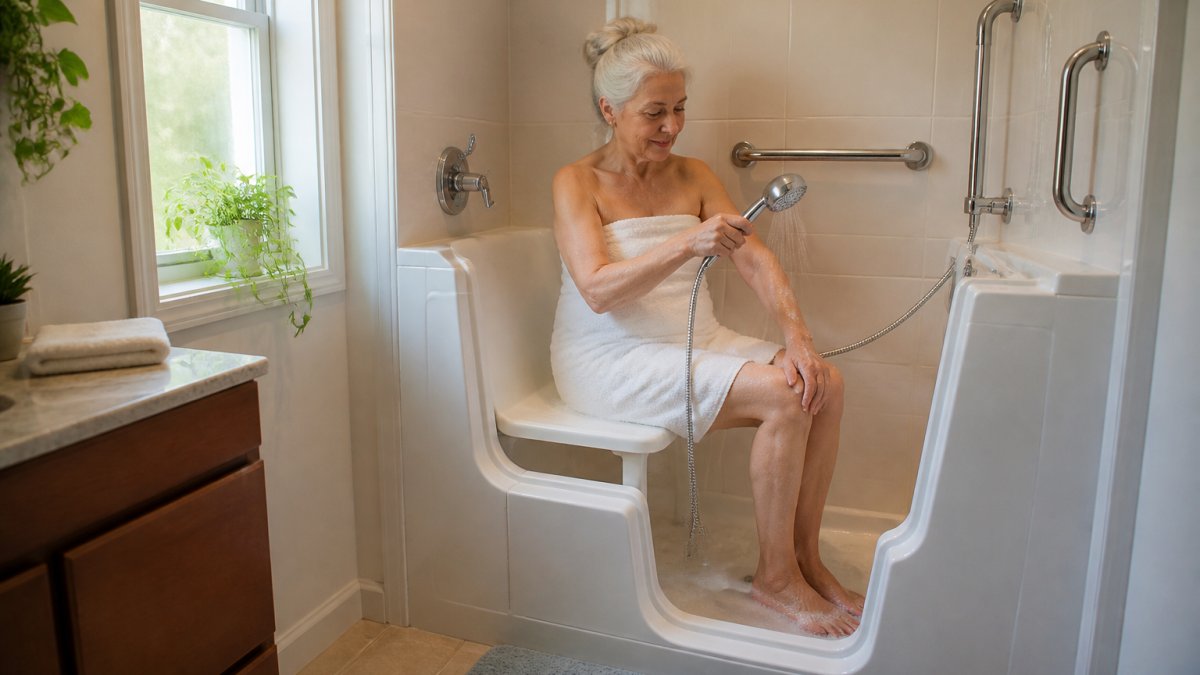
Here is the sequence I teach, broken into the parts that matter.
Before you start: prepare the room and yourself.
- Warm the room first. A space heater or a warm towel reduces shivering and stiffness. Cold muscles are stiff muscles, and stiff muscles are how transfers go wrong.
- Lay out everything within reach before you get wet: soap, washcloth, towel, handheld showerhead, and a dry place to sit. If you have to stand up wet to reach something, it is in the wrong spot.
- Run the water to your tested temperature before you sit down. Test it with your forearm, not your fingertips, because fingertips lie to you as you age.
- Check that the floor is dry where you will step. A wet tile floor is the quiet troublemaker in this whole routine.
Getting in: entry and seating.
- Sit on your shower chair or tub seat first, then swing your legs in carefully. Do not step in and then sit. Sit and then swing.
- Put both hands on something solid as you settle. Grab bars, not the door handle, not the soap dish, not the towel bar.
Washing and rinsing.
- Wash from the top down, rinsing gently with controlled water flow. Top down keeps soap out of places it does not belong and lets gravity help you rinse.
- Keep the handheld showerhead close to your body. A showerhead on a long hose that sprays across the room is a slip waiting to happen.
- Rinse thoroughly, especially under folds and around the feet. Soap residue is a skin irritant, and irritated skin is a fall risk when you scratch in your sleep.
Getting out: the part everyone underestimates.
- Stand only when you feel steady, using grab bars. If you feel lightheaded, sit back down and wait. The water will not run away.
- Dry seated, then rise slowly. Drying while standing on a wet floor is how people end up on the news.
- Step out onto a dry towel or mat, not directly onto tile.
After: cleanup and recovery.
- Rinse the tub or shower floor while you are still in it, if you can do so safely. A clean floor is a safer floor.
- Leave the bathroom door unlocked, or tell someone in the house you are bathing. Privacy matters, but so does being found if something goes wrong.
- Sit down and rest for a few minutes after. Warm water can affect blood pressure, and dizziness can occur after you stand rather than during bathing.
Stop and get help if any of these happen: you feel dizzy or your vision narrows in warm water, you cannot catch your breath, you have chest pain, you cannot feel your feet, or you have fallen in the bathroom before. These are signals that a qualified assessment should come before your next solo bath.
Watch out for the towel bar. It will pull out of the wall, and you will go with it. Proper grab bar placement and installation is worth doing right the first time.
One more thing, and I mean this kindly. A routine is not a prison sentence. If you are exhausted one day, a seated sponge bath at the sink is a perfectly honorable way to stay clean.
When Bathing Alone Is Unsafe and You Need an Assessment
Bathing alone becomes unsafe when you cannot reliably stand, transfer, or recover from a slip without help.
This is not a failure. It is information. You can read a step-by-step walkthrough of how the in-home bathroom safety assessment works and what to expect.
At Bentley Baths, we offer free in-home and virtual evaluations by age-in-place specialists to identify safety liabilities and recommend solutions.
Schedule Your Free Bathing Evaluation
You have options, and you have more time than a pushy salesperson wants you to believe. That is the heart of everything I teach. Do not let a countdown timer decide your bathroom.
If you are shopping, start with the Free Walk-In Tub Buying Review With George and get your questions answered before you spend a dime. If you already have a quote, a Free Walk-In Tub Estimate / Second Opinion costs you nothing but an hour.
Frequently Asked Questions
How can seniors bathe safely without assistance?
Seniors can bathe safely alone by setting up the bathroom first: a shower chair or built-in seat, grab bars, non-slip surfaces, a handheld showerhead, and a walk-in tub with a low threshold. Keep supplies within reach, set the water temperature before entering, and use a routine that avoids rushing. A professional assessment can confirm whether your mobility and bathroom layout support independent bathing.
What bathing options help older adults maintain independence?
Accessible bathing options for older adults include walk-in tubs, roll-in showers, transition tubs, and shower chairs with handheld showerheads. Each supports independence differently: walk-in tubs offer seated soaking and showering, while roll-in showers provide step-free entry. The right choice depends on mobility level, bathroom space, and budget. A free in-home evaluation can help match equipment to your specific needs.
Are walk-in tubs suitable for seniors with limited mobility?
Walk-in tubs can suit many seniors with limited mobility because they have low entry thresholds, built-in seats, and grab bars. However, they are not right for everyone. Some mobility limitations require a roll-in shower or an occupational therapy assessment. Walk-in tub safety features like anti-scald valves and non-slip floors help, but no product guarantees fall prevention. An age-in-place specialist can advise on suitability.
What should you consider before choosing a walk-in tub?
Before choosing a walk-in tub, consider your bathroom size and door width, your hot-water supply, electrical needs for massage systems, and the installation scope. Ask for a written estimate that details plumbing, electrical work, and warranty terms. Also compare walk-in tub vs accessible shower for your mobility needs. A free buying review with George Bentley can help you avoid costly mistakes.
When should a senior ask for help with bathing?
A senior should ask for help with bathing if they feel unsteady standing, have difficulty transferring, or have experienced a near-fall in the bathroom. Other signs include fatigue during bathing, skin fragility that needs gentle handling, or cognitive changes that affect safety. A professional assessment can determine whether independent bathing is safe or if caregiver support or equipment changes are needed.
Is a walk-in tub or an accessible shower a better choice?
A walk-in tub is better if you want deep soaking, hydrotherapy, and seated showering in one fixture. An accessible shower is better if you need step-free entry, use a wheelchair, or have very limited transfer ability. Both can support independent bathing. The decision hinges on your mobility, bathroom layout, and whether you value soaking. Compare both options with a specialist before buying.
What features make a bathroom easier to use independently?
Features that make a bathroom easier to use independently include grab bars, non-slip flooring, a shower chair or bench, a handheld showerhead, lever-style faucets, and adequate lighting. A walk-in tub with a low threshold and built-in seat adds safety and comfort. Keep frequently used items within reach and consider a comfort-height toilet. An in-home evaluation can identify specific changes for your bathroom.
The challenge is simple: most people wait for a fall before they act. You do not have to. Bentley Baths offers free in-home and virtual evaluations by an age-in-place specialist, walk-in tubs and ADA-compliant shower systems, and honest guidance on what your bathroom actually needs. Get started with Bentley Baths and keep bathing on your own terms.